6 months ago
Master How to Export YouTube Comments to Excel
If you’ve ever tried to make sense of a YouTube comment section, you know it’s a wild mix of spam, genuine praise, tough questions, and everything in between. The fastest way to cut through that noise is to pull all of it into a spreadsheet. Using a dedicated tool like the YouTube Comments Downloader makes this incredibly simple. You just feed it a video URL, choose XLSX as your format, and it hands you a perfectly organized file, complete with threaded replies and all the metadata you need.
Why Bother? Because YouTube Comments Are a Goldmine
It’s easy to dismiss the comment section as just noise, but that’s a huge mistake. For anyone trying to build an audience or a brand on YouTube, those comments are a direct, unfiltered line to what people are really thinking. Getting that raw feedback out of YouTube and into an organized spreadsheet is the first step to turning chaotic chatter into actionable intelligence.
When you export comments to Excel, you’re building a dataset you can actually work with. It is about moving past guesswork and finally having concrete data to back up your decisions.
Find the Strategic Value Hiding in Plain Sight
For marketers, this is where you can strike gold. Imagine being able to instantly search and filter thousands of comments from your latest ad campaign. You can isolate every mention of “price,” “how to,” or “competitor,” revealing customer pain points and questions your team might have missed. These are the organic testimonials and raw objections that shape powerful marketing messages.
For creators, it is a content roadmap. You can spot highly-requested video ideas, check the pulse of your community by tracking sentiment, and even identify your biggest supporters to build stronger relationships. It is the difference between hearing a thousand voices at once and having a clear, focused conversation with your audience. We dive much deeper into this in our guide on how to do social listening on YouTube.
Before we get into the “how-to,” it helps to see the big-picture advantages. Exporting comments is not just about archiving data; it is about creating strategic opportunities.
Core Benefits of Exporting YouTube Comments
| Benefit | Impact for Creators & Marketers |
|---|---|
| Sentiment Analysis | Quickly gauge audience reaction (positive, negative, neutral) to new content or product announcements without manual reading. |
| Audience Research | Uncover demographic clues, language patterns, and common interests directly from your target audience’s own words. |
| Content Ideation | Identify recurring questions and popular topics that can be turned directly into your next high-engagement video. |
| Product Feedback | Collect raw, unfiltered feedback on features, pricing, and usability to inform product development cycles. |
| Community Management | Pinpoint top fans, influential commenters, and brand advocates to foster a stronger, more engaged community. |
This process gives you a clear, structured view of what your audience truly wants, needs, and thinks, a massive competitive advantage.
This Isn’t a Niche Tactic Anymore
The importance of comment analysis has exploded recently. People are not just passively watching videos anymore; they are actively participating in community discussions. For instance, recent data shows the average number of comments per video shot up by an incredible 38% in the last year. With the YouTube algorithm heavily favoring engagement, you cannot afford to ignore this trend.
By exporting and organizing this data, you can finally:
- Spot trends before they become obvious.
- Measure audience sentiment at a glance.
- Find your most passionate fans and start building real connections.
For those looking to take it even further, specialized tools like a YouTube Comment Engine can even help you pinpoint potential sales leads within the conversations. At the end of the day, knowing how to export YouTube comments to Excel has become a fundamental skill for serious growth on the platform.
The Easiest Way to Export YouTube Comments
Let’s be honest, you are not looking for a coding project or a tedious copy-paste marathon. You just want to get all the comments from a YouTube video into a spreadsheet so you can start analyzing them. The good news is, a dedicated tool like the YouTube Comments Downloader turns this entire task into a few simple clicks.
Forget about needing to be a data guru. The process is dead simple: you paste the video’s link, pick your file type, and hit download. It is designed to get you from A to B without the usual technical headaches, freeing you up to focus on what the comments are actually telling you.
From Raw Conversation to Actionable Insights
The whole point of this exercise is to turn the chaotic stream of audience feedback into clean, organized data. Once you have that, you can spot trends, find top-rated feedback, and really understand what your viewers are thinking.
It’s a straightforward path: the conversation happening on your video becomes data in a spreadsheet, which you can then use to generate real insights for your channel or brand.
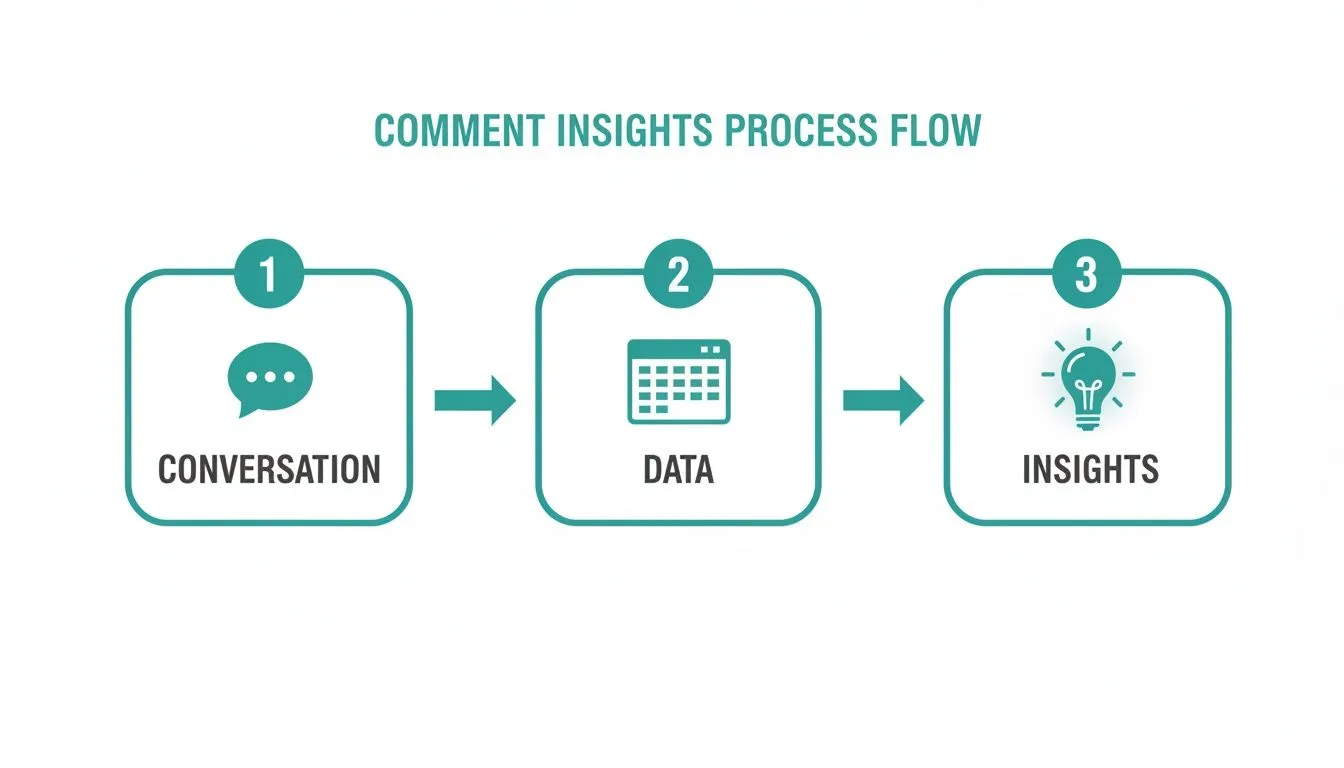
The right tool simply bridges the gap between your audience’s voice and your strategic planning.
To get started, all you need is the URL of the YouTube video you want to analyze. Just go to the video, it can be a standard upload, a Short, or even a replay of a past live stream, and copy the link from your browser’s address bar. That link is your key.
Your Step-by-Step Export Guide
With your video link copied, head over to the YouTube Comments Downloader website. The first thing you’ll notice is how clean the interface is. There’s no clutter, just a single input field waiting for you.
Paste your link right into that box. This is your command center for the entire export.
Now, for the file format. You have a couple of solid options here.
- For Excel users, choose XLSX. This is the modern Excel format. Your file will download as a perfectly formatted spreadsheet, ready to go the second you open it. No extra steps needed.
- For broader compatibility, pick CSV. A CSV (Comma-Separated Values) file is a universal format that plays nicely with just about anything, including Google Sheets, Apple Numbers, and other data analysis programs.
My Pro Tip: If you’re planning to work in Excel, always go with XLSX. It saves you the minor but annoying step of having to format a plain CSV file. It’s the fastest path from download to analysis.
What Data You’ll Actually Get in Your Export
This is what truly separates a professional tool from a basic script or a simple copy-paste job. Grabbing just the comment text is easy, but you lose all the valuable context. A proper export gives you the complete picture.
Here’s a breakdown of the rich metadata you’ll get with every single comment:
- Full Comment Text: The entire comment, not a shortened version.
- Author Details: The commenter’s name and a direct link to their channel.
- Engagement Metrics: The like count and the number of replies for each comment.
- Timestamp: The precise date and time the comment was posted.
- Thread Hierarchy: Replies are correctly nested under their parent comments, so you can follow the flow of a conversation.
This is the kind of data that allows for real analysis. You can sort by the most-liked comments to find what resonates, filter by date to track sentiment over time, or even check out the author channels to identify potential influencers within your audience. When you export YouTube comments to Excel the right way, you are not just getting text, you are getting a complete dataset ready for deep-dive analysis.
Alright, you’ve got your YouTube comments exported and sitting in an Excel file. Now for the fun part: turning that mountain of raw text into something you can actually use. This is where you go from just collecting data to really analyzing it, digging into the conversations to find out what your audience is truly thinking. Forget about complicated formulas; this is all about using Excel’s straightforward tools to get some real answers.
When you use a professional tool to export comments, you’ll usually get a choice between formats like XLSX and CSV. Think of an XLSX file as your fast-track option. It opens in Excel with everything already organized into neat columns, ready for you to sort and filter immediately. It is this kind of pre-formatted data that has been a game-changer, letting everyone from marketers to academic researchers quickly dive into audience behavior without a messy setup.
Find Your Most-Liked Feedback in Seconds
One of the first things I always do is find out what resonated most with people. Your exported sheet will have a Like Count column, and that’s pure gold.
Just use Excel’s Sort & Filter function on that column to arrange it from largest to smallest. Instantly, the most-liked comments pop right to the top.
- Here’s a real-world example: Say you’re a brand that just dropped a video for a new gadget. Sorting by likes will show you exactly which features are getting people excited. A comment with 500+ likes that says, “YES! A battery that actually lasts all day!” is not just feedback, it is a powerful testimonial you can use in your next ad campaign.
This one simple sort turns a wall of text into a ranked list of your audience’s favorite points.
Pinpoint Key Topics with a Quick Search
Your comment section is basically a free, unfiltered focus group. To make any sense of it, you need to search for specific themes. This is where Excel’s search function, Ctrl+F on Windows or Cmd+F on a Mac, becomes your most trusted tool.
A gaming creator, for instance, could search for terms like “bug,” “crash,” or “lag” to collect technical feedback on a new release. If you run a cooking channel, searching for “substitute” or “vegan” will help you spot common questions about adapting your recipes. It is a fast way to group feedback without having to read thousands of comments one by one.
Expert Tip: Don’t just passively read the comments. Go in with a mission. Ask specific questions like, “What are the most common complaints?” or “What new video ideas are people suggesting?” Then use search and filter to hunt down the answers in your data.
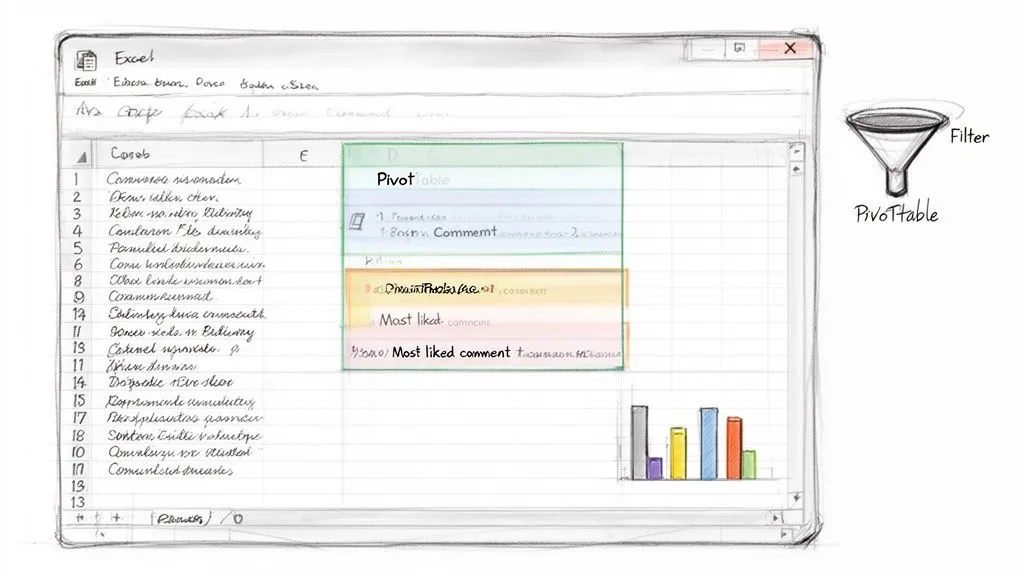
Spot Big-Picture Trends with PivotTables
When you’re dealing with a massive dataset, you need a way to zoom out and see the big picture. For this, nothing beats Excel’s PivotTables. They can take thousands of rows of data and summarize them into a clean, easy-to-read report without a single formula.
For example, a quick PivotTable can show you:
- The total number of comments posted each day, revealing when your audience is most engaged.
- Your top 10 most frequent commenters, helping you identify your channel’s biggest fans.
- How many times competitors are mentioned, giving you a pulse on brand comparisons.
If you plan on using other analysis programs, you might find that a CSV format works better. We have a guide that covers the specifics of exporting YouTube comments to CSV for that very purpose.
Ultimately, PivotTables are the fastest way to go from individual comments to high-level trends, giving you a dashboard-style view of what’s happening in your community.
Going Big: Bulk Exports and AI for Deep Channel Analysis
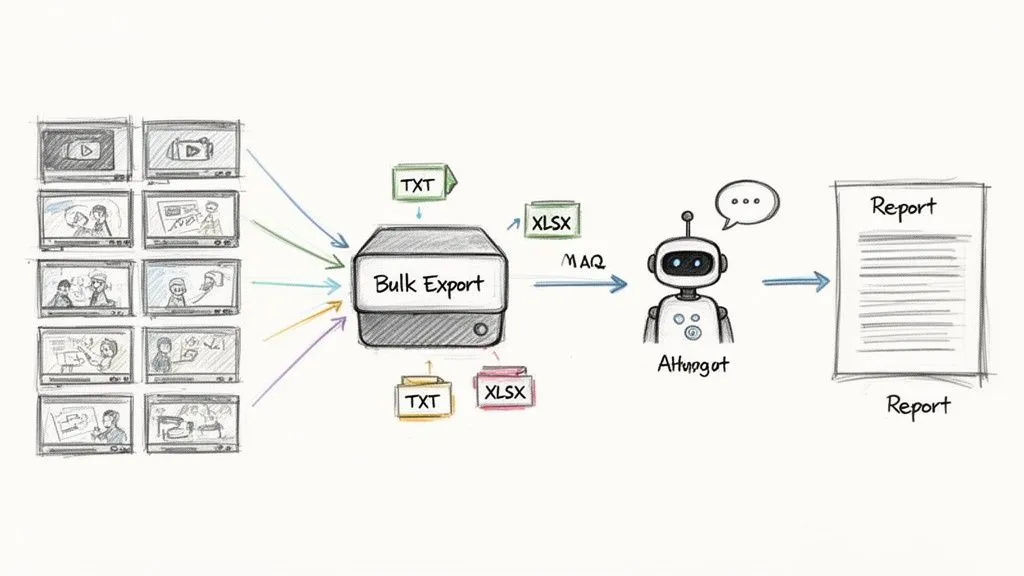
Analyzing comments from a single video gives you a great snapshot. But what if you need to understand the conversation happening across your entire channel? This is the challenge for agencies, researchers, and serious creators who need to see the big picture.
When you need that kind of muscle, you have to move beyond one-off exports. This is where the YouTube Comments Downloader really shines. It is designed to handle bulk exports, letting you grab comments from whole channels, specific playlists, or even community posts all at once. Instead of clicking through videos one by one, you can queue up your entire content library and let it run.
For a marketing agency managing multiple client channels, this is a lifesaver. You can download every comment from the last quarter’s videos to build a single, comprehensive report on audience sentiment, spot trends across different channels, and really prove the impact of your work.
Turning Raw Data Into Smart Insights with AI
Okay, so you’ve exported thousands, maybe tens of thousands, of comments. Now what? Staring at a massive spreadsheet is intimidating. This is the perfect moment to bring in AI to do the heavy lifting for you.
While an XLSX file is great for Excel, the TXT export format is your secret weapon for AI analysis.
A clean TXT file is exactly what language models like ChatGPT love to see. You can literally copy and paste the raw comments directly into the chat and start asking questions. This simple workflow transforms an export tool into a full-blown research platform, letting you jump from raw data to actionable insights in minutes, not days.
Practical Ways to Use AI for Comment Analysis
So what does this actually look like? It is surprisingly straightforward.
- Find Common Themes: Paste a TXT file with 10,000 comments into your AI tool and ask, “What are the top 5 most discussed topics here?” The AI will instantly read through everything and cluster conversations into themes like “requests for a sequel,” “feedback on audio quality,” or “questions about pricing.”
- Gauge Sentiment at Scale: You can go way beyond a simple keyword search. Ask the AI, “Categorize these comments into positive, negative, and neutral sentiment.” It will pick up on sarcasm and nuance, giving you a much more accurate read on how your audience feels.
- Generate Quick Reports: After you’ve identified themes and sentiment, just ask the AI to “Summarize the key findings in a brief report with bullet points.” You’ll get a clean summary you can immediately share with your team or clients.
If you want to get even better results, you can use more advanced methods like few-shot prompting techniques to guide the AI toward more specific and accurate answers.
This is a genuine game-changer. I recently worked with a researcher analyzing feedback on a public health campaign. They bulk-downloaded comments from over 30 videos and fed the text to an AI. It quickly identified the most common public misconceptions, which gave the team critical data to refine their messaging for the next phase.
This whole process gives you a faster, smarter way to understand what your audience is really talking about. To see this workflow in more detail, check out our guide on how to bulk download YouTube comments for large-scale analysis.
When you need to pull YouTube comments into a spreadsheet, you’ll find a few different paths you can take. While our YouTube Comments Downloader is designed to be the most direct route, it is worth understanding the other options and why they often fall short for business use.
A quick search will turn up many free browser extensions and online scripts. The promise of a free solution is tempting, but these tools often fail more than they succeed. Their biggest problem is reliability. They are notoriously fragile and tend to break the moment YouTube makes a small code update, which happens constantly.
Even when they do work, the data you get is often a mess. Many free tools struggle with videos that have thousands of comments, and they almost never preserve the threaded replies. You end up with a flat file of disconnected comments, which is useless for analyzing conversations.
The Problem with the “Official” Route
Then there is the official YouTube Data API. For a developer, this is the standard, by-the-book method. But for anyone else, a marketer, researcher, or creator, it is a massive detour that requires significant technical skill.
Getting started with the API involves:
- Setting up a Google Cloud project.
- Navigating the API library to enable the right services.
- Generating and securing API keys.
- Writing, testing, and debugging code to make the data requests.
- Carefully managing strict daily usage quotas that are surprisingly easy to hit.
One wrong line of code or an unexpectedly popular video can exhaust your quota for the day, stopping your project in its tracks.
Honestly, using the API for a simple comment export is like building your own car just to go to the grocery store. It’s an interesting technical exercise, but it is an incredibly inefficient way to get the job done when a purpose-built vehicle is ready and waiting.
Comparison of YouTube Comment Export Methods
To put it all in perspective, here’s a direct comparison of the methods we’ve discussed. It should help clarify which approach best fits your specific needs, whether you’re a casual user or a professional analyst.
| Method | Ease of Use | Data Richness | Scalability & Reliability | Best For |
|---|---|---|---|---|
| Dedicated Downloader Tool | Excellent (point and click) | High (threads, metadata) | High (handles large volumes) | Marketers, researchers, and creators needing reliable, structured data. |
| YouTube API | Very Poor (requires coding) | High (very detailed) | Moderate (quota limits) | Developers building custom applications or large-scale academic studies. |
| Browser Extensions / Scripts | Good (when they work) | Low (often no threads) | Very Poor (breaks often) | Quick, one-off exports from small videos where data quality is not critical. |
As you can see, the trade-offs are significant. While the API offers the richest data, its complexity makes it impractical for most. Free tools are easy but unreliable, leaving a dedicated downloader as the clear winner for most practical business and research tasks.
Why a Specialized Tool Is the Smartest Choice
This is exactly why a tool like our YouTube Comments Downloader exists. It is not a generic online utility or a complex library for coders. It was built for one specific job: to get public YouTube comments into a clean, analysis-ready spreadsheet without any friction.
It gives you the power and data richness of the API but without touching a single line of code.
For a marketing team that needs to analyze customer feedback across dozens of videos, the choice is simple. A professional tool delivers the speed, scale, and rich metadata (like replies and author data) that free options just cannot provide. You get clean, structured data every time, so you can spend your time finding insights, not fighting with broken scripts.
Frequently Asked Questions
When you’re new to exporting comments, a few questions always seem to pop up. Let’s walk through some of the most common ones I hear so you can get started with your analysis right away.
Can I Export Comments From Any YouTube Video?
Pretty much, yes. You can pull comments from almost any public video on YouTube. That includes your standard uploads, Shorts, community posts, and even the replays from past live streams.
The only real roadblocks are private videos or any video where the creator has completely turned off the comment section. If you can see the comments in your browser, you can almost certainly export them.
Is Using a Third-Party Tool to Export Comments Safe?
It’s a fair question, and the answer is yes, as long as you stick with a well-regarded tool. A professional service like YouTube Comments Downloader is built specifically for safety. It never, ever asks for your YouTube channel login or password.
These tools only access public data, the same information your web browser sees. This keeps the entire process safe and does not violate YouTube’s terms of service.
The key is that a professional tool operates on a “read-only” basis for public information. It doesn’t need special permissions or access to your private account details, so your channel and personal data are never at risk.
What’s the Real Difference Between XLSX and CSV Files?
It really comes down to how you plan to use the data.
- An XLSX file is a native Excel spreadsheet. It opens up perfectly formatted, with data already sorted into neat columns. If you’re heading straight into Excel for analysis, this is your best bet. It just works.
- A CSV (Comma-Separated Values) file is more of a universal raw data format. It’s great because nearly any data program can open it. The trade-off? When you open a CSV in Excel, you sometimes have to use the “Text to Columns” feature to get everything lined up correctly.
For most people, XLSX is the faster and more convenient choice.
How Many Comments Can I Export at Once?
This is where you see the biggest difference between a simple script and a dedicated tool. A basic script might time out or crash after a few thousand comments.
Professional solutions, however, are built for massive datasets. You can easily export comments from an entire channel or a playlist with hundreds of thousands, or even millions, of comments in a single go. This capability is exactly what you need for serious market research or large-scale academic studies.
Ready to turn messy comment threads into clean, actionable data? The YouTube Comments Downloader can get it done in just a few clicks. Start your free trial today and discover the insights hiding in your audience feedback.