7 months ago
How to Bulk Download YouTube Comments for Quick Market Insights
Yes, you absolutely can bulk download YouTube comments. Whether you need them from a handful of videos, an entire playlist, or even a full channel, it is entirely possible. The trick is to use a dedicated tool that automates the whole process, saving you from the mind-numbing task of manual copying and pasting.
Why YouTube Comments Are a Goldmine for Insights
Let’s be honest: the YouTube comment section is not just for flame wars and “first!” posts anymore. It has evolved into a genuine community hub where your audience, customers, fans, and critics alike, share unfiltered thoughts, ask surprisingly detailed questions, and even debate product features. For any researcher, marketer, or creator, these conversations are pure, unadulterated public data.
Uncovering Trends and Opportunities
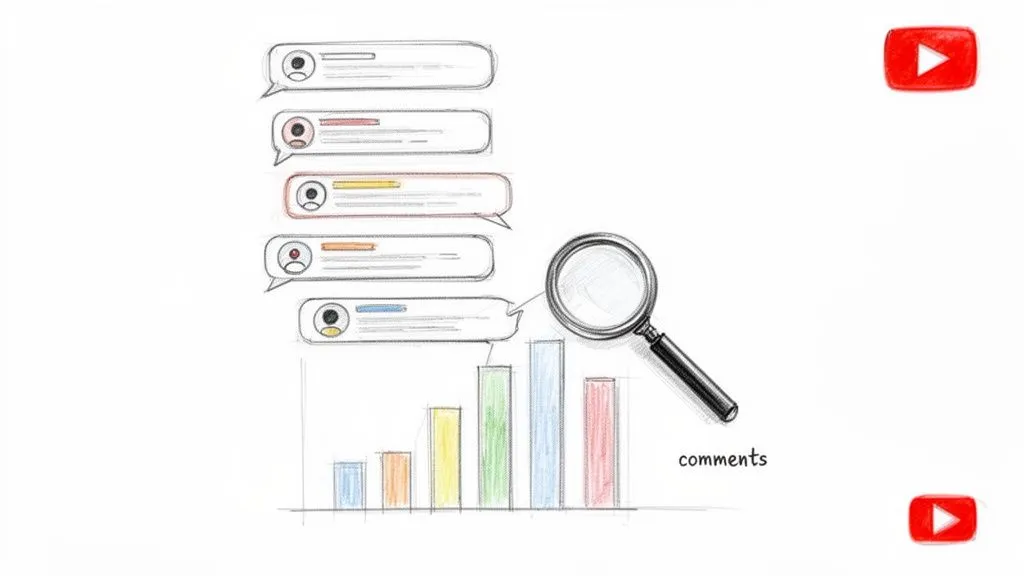
The sheer volume and raw honesty of YouTube comments give you a direct line into what your audience is really thinking. By analyzing this feedback at scale, you can start to see the bigger picture.
- Gauge true customer sentiment: Go beyond likes and views to understand how people genuinely feel about your brand, a new product launch, or a recent marketing campaign.
- Spot content gaps: Are people constantly asking the same questions? That is not a nuisance; it is your next video idea or a clear signal to update your FAQ.
- Track brand perception: See how your brand is being discussed not just on your own channel, but on competitors’ videos and in the wider community.
This all ties back to the well-known benefits of customer feedback and how tapping into it can fuel growth in almost any business.
The Shift to Deeper Engagement Metrics
The data paints a very clear picture. We are seeing a major shift away from passive engagement (like just hitting ‘like’) toward more active, meaningful participation. Between 2024 and 2026, the volume of YouTube comments shot up by an incredible 38%, blowing past the 11% increase in likes during the same period.
Even as overall engagement rates have slightly cooled, this tells us one thing: comments have become the premium metric for measuring real audience connection. For a deeper dive into these numbers, the YouTube statistics report from Metricool is an excellent read.
The ability to bulk download YouTube comments turns this raw chatter into structured, actionable intelligence. Instead of manually scrolling through thousands of entries, you can export them into a single, organized file for analysis.
This simple step is what separates casual observation from serious, data-driven strategy. When you systematically collect and review comments, you start to spot the recurring themes and patterns that matter. If you are curious about the academic frameworks behind this, our guide on discourse analysis methods is a great place to start. It is all about turning that qualitative feedback into quantitative insights that can power smarter decisions.
Choosing the Right Tool for Downloading Comments
When you need to download YouTube comments in bulk, you are at a fork in the road. The method you choose directly impacts your speed, the quality of the data you get, and how much technical heavy lifting is on your shoulders. Your two main paths are building a custom solution with the YouTube API or using a specialized, no-code tool.
Picking the right approach is not about which one is “better” in a vacuum. It is about matching the tool to your skills, your timeline, and what you ultimately need the data for.
The DIY Route: The YouTube API
For anyone with a coding background, especially in a language like Python, the YouTube API can feel like the obvious first choice. It gives you direct, granular access to the data, and in theory, you can customize your script to pull exactly what you want.
But here is the catch that trips up countless projects: the API is not built for bulk jobs. It comes with strict daily quotas and aggressive rate limits that you will hit almost immediately when trying to pull comments from hundreds or thousands of videos. Suddenly, your “simple script” needs complex error handling and exponential backoff logic just to keep from failing. It becomes a full-blown development project, which is a massive time sink for marketers and researchers who just need the data, not a new coding hobby.
A Better Way: No-Code YouTube Comment Tools
Honestly, for almost everyone, a dedicated no-code tool is the smarter move. Instead of wrestling with API keys and quota errors, you get a clean, straightforward interface designed for one thing: downloading YouTube comments at scale. A purpose-built YouTube Comments Downloader handles all the messy backend work for you.
A specialized tool is engineered to do one job exceptionally well. It navigates the API, automatically manages rate limits, and delivers clean, analysis-ready data, letting you focus on your research instead of the technical headaches.
These tools are built to understand YouTube’s data structure, which is crucial for preserving comment threads and replies, something that many DIY scripts struggle to get right.
Why a Specialized Tool Wins for Bulk Projects
The difference becomes painfully obvious once you start a large-scale project. A custom script might sputter along for hours or even days trying to pull comments from a few hundred videos, constantly hitting roadblocks. A specialized tool, on the other hand, is optimized for this exact task.
To give you a real-world example, our tool can process a list of over 3,000 videos and export all 750,000 comments in less than 30 minutes. That kind of speed is simply out of reach for a homemade solution without significant engineering effort.
Comparing YouTube Comment Download Methods
Deciding between a DIY script and a dedicated tool comes down to a trade-off between control and efficiency. This table breaks down what you can expect from each approach.
| Method | Ease of Use | Speed for Bulk Jobs | Data Quality & Metadata | Best For |
|---|---|---|---|---|
| YouTube API Script | Difficult (Requires coding) | Slow (API quotas) | Inconsistent | Developers with plenty of time to spare for a side project. |
| No-Code Tool | Easy (Point and click) | Fast (Optimized for scale) | Excellent (Threads preserved) | Marketers, researchers, and creators who need data quickly. |
While the API offers a high degree of flexibility, that freedom comes at a steep price in time and complexity. If your main goal is getting to the analysis, not becoming an API expert, a dedicated tool is the only practical choice.
You can explore some of the different tools available for downloading comments and find one that fits right into your workflow.
How to Bulk Download Comments with a No-Code Tool
Alright, let’s get practical. Forget wrestling with code or hitting frustrating API quotas. Using a dedicated no-code tool is the most direct path to getting the YouTube comment data you need, and the whole process is surprisingly quick.
The first thing you will need is a list of your targets. The good news is you do not have to track down every single video link. A proper bulk tool lets you build a project using a mix of sources.
You can feed the tool a list of:
- Individual video URLs: Perfect for when you need comments from a hand-picked, specific set of videos that are not otherwise grouped together.
- Playlist links: This is a huge time-saver for analyzing feedback on a series, like multi-part tutorials or a season of podcast episodes.
- Channel IDs or URLs: The best option for a wide-angle view, like a full competitive analysis or auditing your own brand’s sentiment across all content.
Configuring Your Bulk Export
This is where a specialized tool really earns its keep. Instead of getting one massive, messy data file, you can choose the exact format you need for your project. Making the right choice here can literally save you hours of data cleaning down the line.
For instance, if you are a marketer doing sentiment analysis, you will probably want an XLSX file to jump straight into Excel or Google Sheets. A developer might prefer JSON to maintain the nested structure of comment threads for an app integration. And for qualitative analysis or training an AI model, a clean TXT file is often the simplest, most effective choice.
This flow diagram really shows how a no-code tool cuts out the usual busywork, taking you straight from your query to usable data.
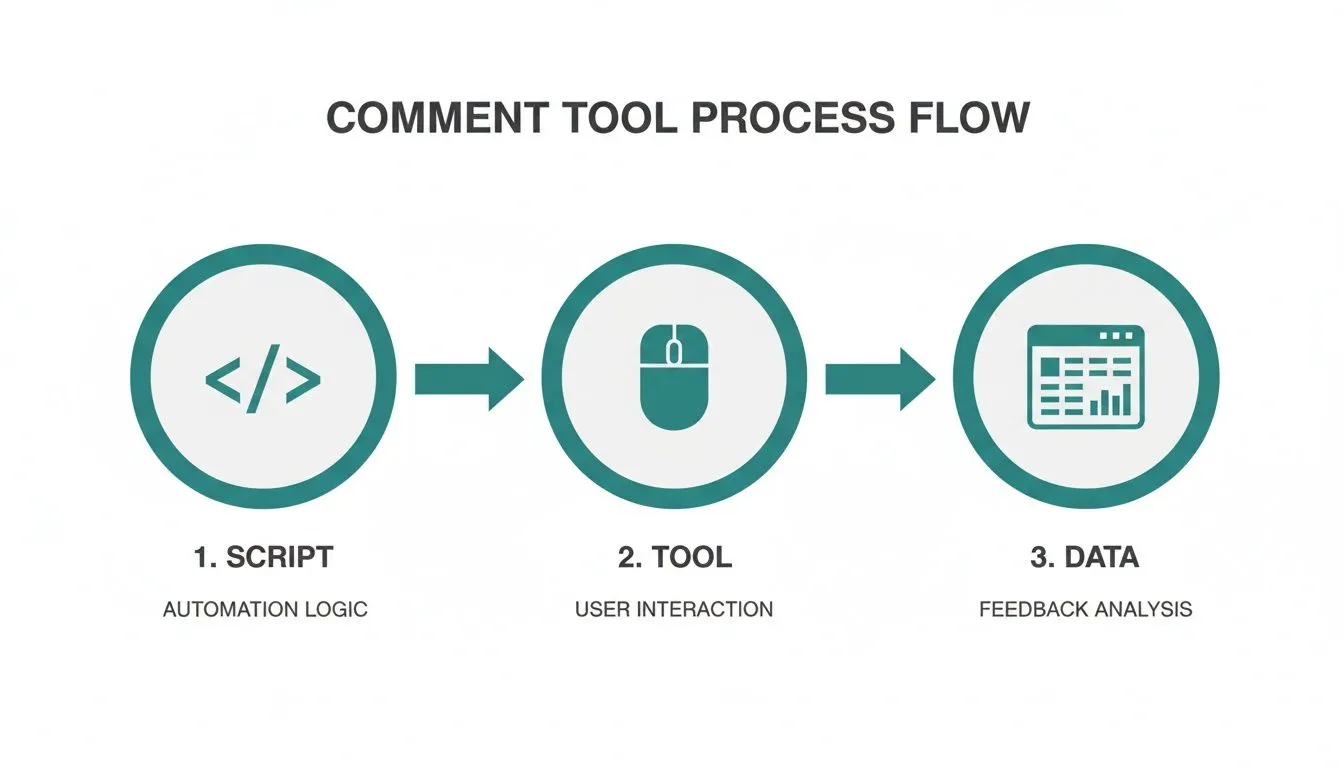
As you can see, the tool handles all the complex scripting behind the scenes. Your job is just to tell it what you need and click a button.
Launching the Job and Using the Data
With your sources and settings locked in, you just hit “go.” The tool then gets to work in the background, methodically pulling comments from every video, playlist, or channel you listed. Most will even show you the progress in real time.
Here’s a real-world example: A marketing manager wants to see what customers are saying about a competitor’s 50 latest product launch videos. They just paste the channel’s URL into the tool, choose XLSX format, and start the export. In a few minutes, they have a detailed spreadsheet. Every comment is tied to its source video, complete with author info, like counts, and most importantly, preserved reply threads.
That last part about preserving threads is crucial. You are not just getting a list of comments; you are getting the actual conversations. Seeing who replied to whom provides the context you need for any meaningful analysis. You can see exactly how this works with our tool by checking out the guide to starting a bulk download for playlists and channels.
What to Do With Your Comment Data: Finding the Gold
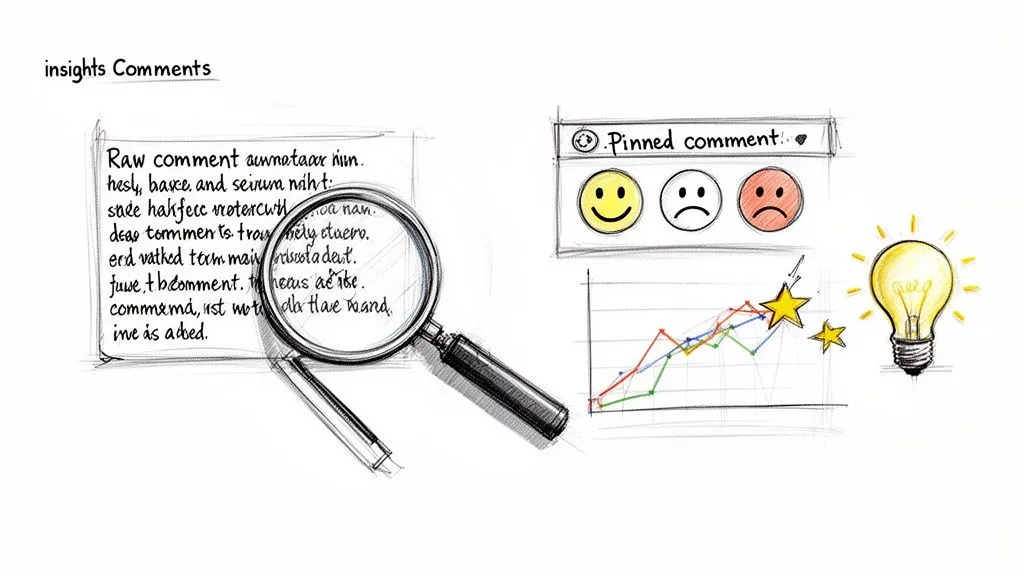
You have done the heavy lifting and now you are staring at a massive spreadsheet or text file filled with thousands of YouTube comments. It can feel a little overwhelming, but this is where the real work, and the real fun, begins. That raw data is a goldmine of feedback, ideas, and market intelligence.
The trick is knowing how to sift through it all. You have collected the data, but now it is time to actually analyze qualitative data and pull out the insights that matter.
Uncovering Insights for Marketers and Researchers
For anyone in marketing, a bulk comment export is like having a direct line into your audience’s brain. Forget expensive focus groups for a moment. Just open your spreadsheet and hit Ctrl+F (or Cmd+F) to search for mentions of your competitors. You will get an unfiltered look at how people compare your products.
This is also an incredible way to spot customer pain points. If you see dozens of comments saying your “setup process is confusing,” you have just been handed a critical piece of feedback. That is a clear signal to fix your onboarding materials, and you did not have to wait for support tickets to pile up.
Academic researchers can find just as much value here. A well-preserved dataset, especially one with comment threads intact, is perfect for studying the dynamics of online conversations. You can track how language evolves, how community leaders emerge, and how certain topics trend over time.
Quick Wins for YouTube Creators
If you are a creator, your audience is constantly telling you what they want to see next. Your comment export is basically a giant suggestion box.
One of the simplest and most effective things you can do is sort your spreadsheet by like count. This immediately surfaces the most popular comments, the ones that resonated most with your community. Pinning one of these to the top of your video is a great way to boost engagement and acknowledge your top fans.
But do not stop there. This data is your content calendar in disguise.
- Find FAQ ideas: Do a quick search for question marks (“?”) to instantly pull up all the questions people are asking. If the same question appears over and over, you have got the topic for your next FAQ video.
- Discover your next video: Look for phrases like “you should do a video on” or “can you explain how to.” Your audience is literally telling you what they will click on.
- Spot your biggest fans: Take note of the people who write the most-liked or most-replied-to comments. These are your super fans, and they are invaluable for building a strong community.
When you have all your comments in one organized file, your audience stops being a passive group and becomes an active collaborator. You can move from guessing what to create to making decisions based on direct, structured feedback.
Using AI to Speed Up Your Analysis
Manually sifting through tens of thousands of comments is not always practical. This is where AI tools can be a game-changer. A clean TXT export is particularly useful here, as you can copy and paste the entire contents directly into a tool like ChatGPT.
Instead of spending days reading, you can give the AI a simple prompt. Ask it to “summarize the top five themes in these comments,” “identify the overall sentiment,” or “pull out five quotes that represent negative feedback.”
This process can turn what used to be a week-long analysis project into something you can get done in an afternoon. You are not just pulling raw data anymore; you are quickly getting the answers you need to make smarter decisions.
Handling Advanced Scenarios and Common Issues
So you have set up your bulk export, but the reality of data collection is that things rarely go perfectly. What happens when you hit a video with comments turned off? Or one that is locked in certain regions? And how do you even begin to pull meaningful data from live stream chats or community posts?
These are the exact scenarios where a simple script or a basic tool tends to fall apart. Anyone who has tried to pull comments from hundreds of playlists using the raw YouTube API knows the pain. You almost immediately slam into strict rate limits and daily quotas, bringing your entire process to a screeching halt. It is a massive headache when all you want is the data.
A professional tool is built to anticipate these roadblocks. It knows how to play nice with YouTube’s backend rules, automatically pacing its requests to stay within the limits. This means your large-scale jobs actually finish without you having to manually restart them or write complex error-handling code.
Exporting from Live Streams and Community Posts
It is easy to forget that not all conversations on YouTube happen under a standard video. The discussions in live stream replays, YouTube Shorts, and community posts are goldmines of audience feedback, but they are structured differently, which can easily trip up less-capable tools.
Take live stream replays, for example. A comment from a live chat includes a crucial timestamp showing exactly when it was posted during the stream. That context is everything, it links audience reactions to specific moments. A tool designed for this will capture that timestamp correctly, while most others will either miss it or fail to process the video entirely.
Our downloader is built to navigate these different formats, so you never miss a piece of the conversation:
- Live Stream Chats: It pulls the comments and, just as importantly, their in-stream timestamps.
- YouTube Shorts: It correctly extracts comments from the vertical short-form video format.
- Community Posts: It gathers feedback from text-based updates and polls, not just your videos.
This gives you a complete view of a creator’s engagement, not just a partial one based on their main video uploads.
The true value of a dedicated tool is not just about speed, it is about reliability. It is the confidence of knowing that whether you are pointing it at a standard video or a live stream replay, you are going to get clean, complete, and accurate data every single time.
Overcoming Roadblocks Like Disabled Comments
And then there is the inevitable cleanup. You will always run into videos where the comments are disabled, private videos mixed into a public playlist, or content that is region-locked. A homemade script will likely crash or just stop when it hits one of these.
A smarter tool handles this without breaking a sweat. Instead of derailing the whole job, it simply notes the issue, skips the problematic video, and moves on to the next one in your list. This simple but critical feature prevents one bad apple from spoiling the whole batch, saving you a ton of time and frustration.
Got Questions About Downloading YouTube Comments?
If you are thinking about downloading YouTube comments in bulk, you probably have a few questions. It is smart to get a handle on the technical and legal details before you dive in. Let’s walk through the most common concerns we hear from people doing this for the first time.
Is It Legal to Download Public YouTube Comments?
This is the first question on almost everyone’s mind, and the short answer is yes, it is generally fine. When you are gathering publicly available information for research, journalism, or market analysis, it usually falls under fair use. Think of it like how a search engine crawls and indexes public websites.
The important word here is public. You should only be collecting data that anyone can see on YouTube without needing special access. It is crucial to follow YouTube’s Terms of Service and respect user privacy by focusing only on data that has been openly shared. Our tool is built to work strictly within these lines, only accessing what is visible to any regular user.
What’s the Best Data Format for My Analysis?
Picking the right file format upfront can save you hours of work later. The best choice really boils down to what you want to do with the data.
- XLSX (Excel): This is the go-to for most marketers, researchers, and creators. You get a clean, structured table that you can open right away in Excel or Google Sheets to sort, filter, and search.
- JSON: If you are a developer, this is your best bet. JSON preserves the nested structure of comment replies, which is perfect for feeding the data into a custom application or database.
- TXT: The simplest format, and often the best for AI analysis. A clean text file is exactly what you need to feed comments into a model like ChatGPT for sentiment analysis or summarizing key themes.
We also offer an HTML export, which is fantastic if you need to create a clean, visual presentation or grab a screenshot of a specific comment thread.
How Many Comments Can I Download at Once?
The number of comments you can pull is almost completely dependent on your method. If you try to build a custom script using the official YouTube API, you will slam into strict daily quotas pretty quickly. This makes it incredibly slow and impractical for any serious, large-scale project.
A dedicated no-code tool, on the other hand, is built for scale and speed. Our solution can handle bulk jobs of over 3,000 videos and pull more than 750,000 comments in under 30 minutes. That kind of performance makes it one of the most reliable options available for serious data collection.
Can I Download Comments from Live Streams and Shorts?
Yes, but this is where many scripts and basic tools fall apart. The data structure for comments on regular videos, live stream replays, YouTube Shorts, and community posts are all slightly different. You need a specialized tool that knows how to handle these variations.
For instance, a comment on a live stream replay includes a timestamp that links it to a specific moment in the video, invaluable context for analysis. Our tool is designed to capture all of this unique metadata, ensuring you get a complete and context-rich dataset, no matter where the conversation happened.
Ready to stop manually copying and pasting and start getting powerful insights? With YouTube Comments Downloader, you can run your first bulk export in minutes. Get the clean, structured, and analysis-ready data you need to make smarter decisions.