7 months ago
Discourse Analysis Methods: Unlock YouTube Comment Insights in 2026
Discourse analysis isn’t just about reading words; it’s about understanding what’s happening between the lines. Think of it as a set of techniques for studying language in its natural habitat: the real world. These methods help us unpack the social context, power dynamics, and hidden meanings woven into our conversations.
That’s why they’re perfect for making sense of the rich, chaotic discussions happening in YouTube comments.
What Are Discourse Analysis Methods and Why Use Them on YouTube?
Imagine you’re a detective, but instead of a crime scene, your investigation is a conversation. You’re not just taking statements at face value. You’re looking for subtle clues about relationships, influence, and the unspoken rules of a community. This is exactly what discourse analysis methods empower you to do. They’re frameworks for figuring out what people are really doing when they communicate.
YouTube comment sections, which can swell with thousands of replies under a single video, are a goldmine of this kind of raw, unfiltered conversation. For marketers, researchers, and creators, these comments are a direct channel into audience mindsets and cultural trends. Applying discourse analysis turns those messy threads into a source of powerful, actionable insights.
Uncovering Deeper Meanings in Conversations
At its heart, discourse analysis helps you answer questions that a simple keyword count could never touch. Instead of only knowing what people are saying, you start to understand how and why they’re saying it. This means paying attention to things like:
- Language Choices: Why did someone use that specific word or phrase? What does it signal?
- Interaction Patterns: How do users agree, disagree, or build on each other’s points in a reply chain?
- Underlying Assumptions: What shared beliefs or worldviews are shaping the entire conversation without ever being explicitly stated?
This whole approach falls under the wider umbrella of qualitative data analysis techniques, where the goal is to interpret non-numerical data to understand complex social realities.
From Academic Theory to Practical YouTube Insights
Discourse analysis has come a long way since the 1970s. It started with basic linguistic studies but has since grown into a powerful tool for revealing social power structures, with Critical Discourse Analysis (CDA) being a major development.
Today, these methods are more relevant than ever. Creators can analyze comments from videos with millions of views, like a political Short that sparks over 750,000 comments. Applying a rigorous analytical framework can even help quantify ideological trends; some studies have found that 40% of the discourse in viral videos can reinforce echo chambers. You can dig deeper into these trends by exploring research on the evolution of discourse analysis.
By turning raw comment data into an Excel-ready format, you transform viewer interactions into measurable insights on community power dynamics, all within minutes.
To make any of this practical, you first have to wrangle messy comment threads into clean, organized data. Manually copying thousands of comments just isn’t feasible. A specialized tool is essential. It lets you export entire comment sections into a structured spreadsheet, ready for analysis. You can learn how to download YouTube comments for analysis and get started right away. This is the crucial step that bridges powerful academic theory with real-world application, making sophisticated analysis accessible to everyone.
Choosing the Right Discourse Analysis Method for Your Goal
With so many different discourse analysis methods out there, picking the right one can feel a bit daunting. The best way to think about it is that each method is a specialized tool, and your research question is the job you need to get done.
Before you jump into the analysis, take a step back and get crystal clear on your objective. What are you really trying to uncover from the YouTube comments? Are you curious about how a brand’s new marketing slogan is landing with its audience? Or are you more interested in the subtle power dynamics playing out in the comments of a political video? Your goal is the signpost that points you directly to the right method.
This first step is absolutely critical. Picking the wrong method is like trying to saw a plank of wood with a screwdriver; you’ll make a mess, and you won’t get the clean cut you were looking for.
Matching Your Goal to the Right Method
So, how does this work in practice?
Let’s say you want to track how the conversation around a new product launch evolves over a series of videos. In this case, a discourse-historical approach is your best bet. It’s designed specifically to trace how language, themes, and sentiment shift over time, using the dates and timestamps in your exported YouTube comment data.
But what if your focus is on the back-and-forth between a creator and their fans? For that, Conversation Analysis is perfect. This method zooms in on the turn-by-turn mechanics of a dialogue, helping you dissect how people agree, argue, and build on each other’s ideas within a single comment thread.
This decision tree gives you a great visual starting point, helping you figure out if your main interest is in what people are saying or why they’re saying it that way.
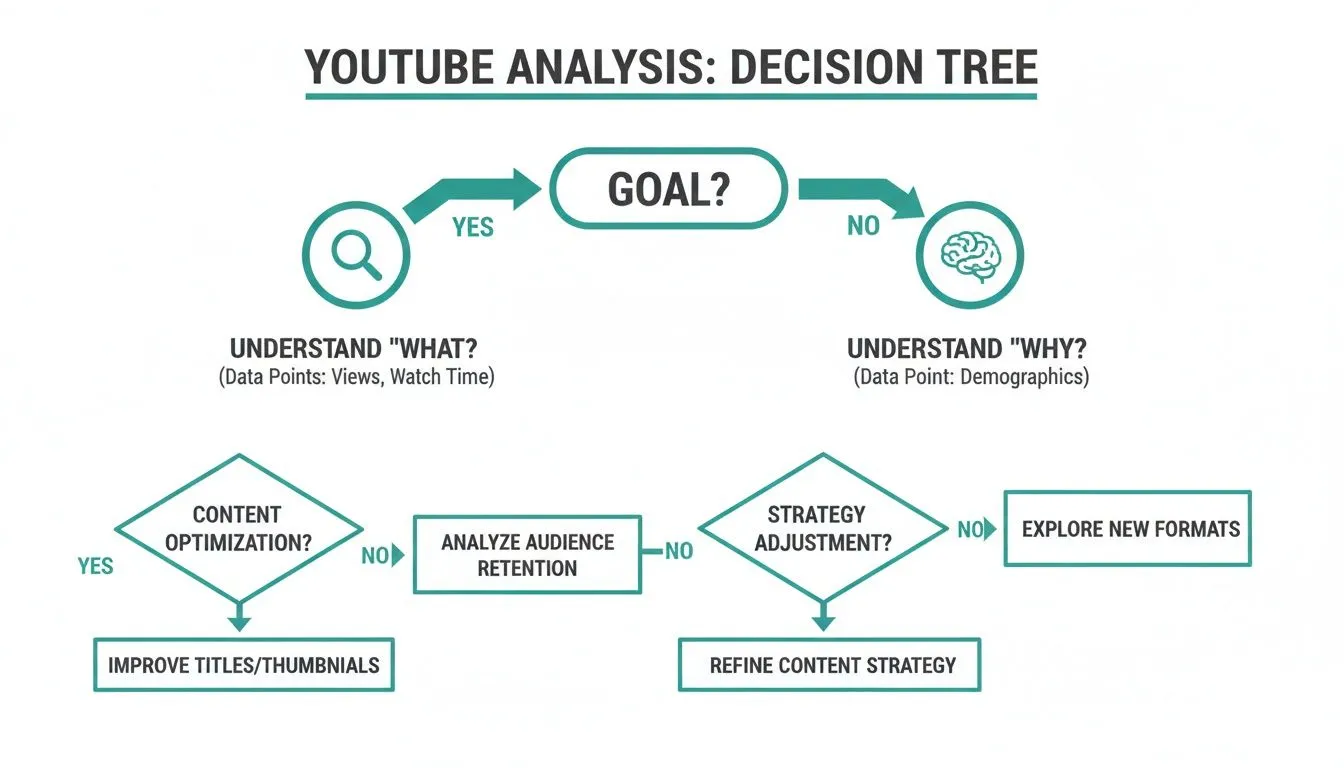
As you can see, the fundamental fork in the road is whether your analysis needs to uncover the substance of the comments or the social forces shaping them.
Matching Your Research Goal to a Discourse Analysis Method
To make this choice even more straightforward, I’ve put together a table that connects common research goals with the most suitable method. Think of it as a quick-reference guide for your YouTube comment analysis.
| Your Research Goal | Recommended Method | Best For Analyzing… | Example YouTube Application |
|---|---|---|---|
| Uncover power structures and hidden ideologies. | Critical Discourse Analysis (CDA) | The language used to assert dominance, create in-groups/out-groups, and challenge or support authority. | Analyzing comments on a corporate social responsibility video to see if viewers accept or resist the company’s framing. |
| Track how topics and narratives change over time. | Discourse-Historical Approach (DHA) | The evolution of key terms, arguments, and sentiment across multiple videos or over a long period. | Downloading all comments from a channel’s Community posts in 2025 to trace shifts in audience concerns. |
| Understand the structure of conversations. | Conversation Analysis (CA) | Reply chains, turn-taking, and how users interact to co-construct meaning, agree, or argue. | Examining the reply threads on a product review to see how users collaboratively solve a problem or debate a feature. |
| Analyze how text, images, and other modes interact. | Multimodal Discourse Analysis | The combined meaning created by text, emojis, user avatars, and references to the video’s content (via timestamps). | Studying comments on a movie trailer to see how emojis (e.g., 🔥, 😴) and timestamped reactions create a collective emotional response. |
Ultimately, the single most important thing you can do is take a moment to deliberately match your goal with the right framework. Doing this upfront ensures your analysis is focused, sharp, and capable of delivering real insights. It’s what keeps you from getting lost in the weeds of academic theory and points you straight toward the answers you’re looking for.
Uncovering Power and Ideology with Critical Discourse Analysis
Some methods of discourse analysis are content with counting what is said. But to get to the really interesting stuff, you have to ask why it’s said in a particular way. That’s the job of Critical Discourse Analysis (CDA).
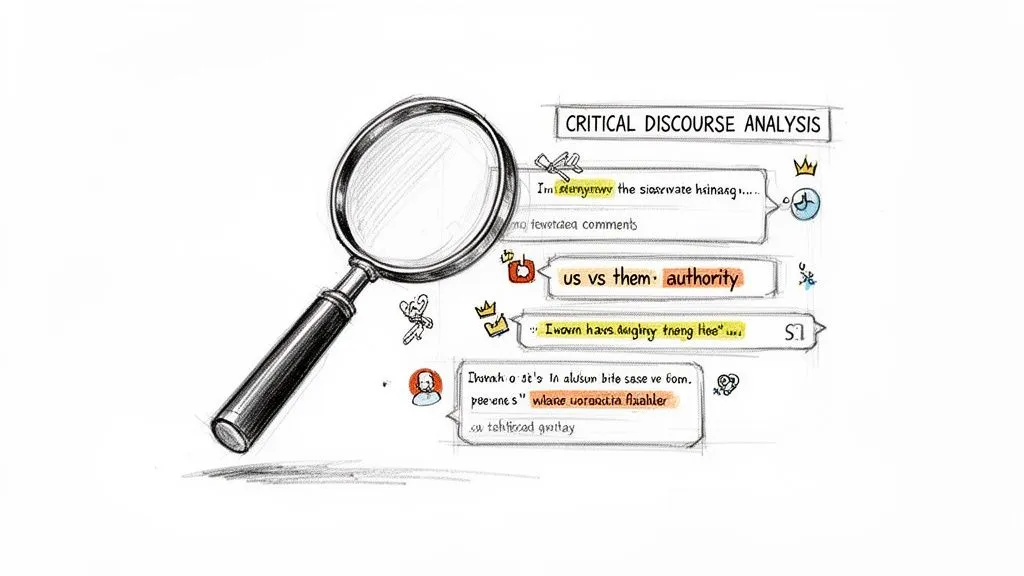
Think of it as the art of reading between the lines. CDA is all about uncovering how language is used to build, reinforce, or even challenge power structures and social beliefs. It starts from a simple but powerful premise: language is never neutral. Every word choice, every argument, and even what’s left unsaid serves a purpose. It either props up the status quo or tries to tear it down. This makes CDA a fantastic tool for making sense of YouTube comments, where public opinion and ideologies are constantly clashing.
From Theory to YouTube Comment Analysis
Don’t let the name fool you; CDA isn’t just an abstract theory for academics. You can apply its principles directly to the massive datasets of YouTube comments to find real, concrete insights. The trick is to look for specific linguistic clues that reveal the power dynamics bubbling just beneath the surface.
Since it emerged in the 1980s, CDA has become a go-to method for dissecting how language can create or sustain inequality. Research shows it’s highly effective at exposing ideological biases in up to 75% of media texts by connecting small linguistic details to big socio-political trends. For example, a channel manager might download all the comments from a playlist and find that around 40% of the top replies are actively pushing back against the video’s main point, a modern-day tug-of-war for authority. You can find more examples of the applications of discourse analysis on Looppanel.com.
By identifying these patterns in YouTube comments, you can map out the invisible ideological battles happening within your audience, revealing whether your message is being accepted, co-opted, or outright rejected.
A Practical CDA Workflow for YouTube Comments
Applying CDA isn’t magic; it’s a systematic process. It’s about creating a clear path from a messy pile of comments to sharp, meaningful insights. Here’s a workflow you can follow.
- Export Relevant Comments: First, pick a video where power, politics, or ideology are likely to be hot topics. Think corporate announcements, political commentary, or controversial news clips. Use a comment downloader to get all the comments into a manageable XLSX or CSV file.
- Prepare Your Dataset: With the file in hand, it’s time to clean it up. You might filter for just top-level comments to see people’s initial gut reactions, or maybe you want to isolate a single, fiery debate thread. The goal here is to narrow your focus to match your research question.
- Identify Linguistic Markers: This is the heart of CDA. Read through the comments and start hunting for recurring patterns that signal power dynamics. Keep an eye out for things like:
- Exclusionary Language: Phrases that draw a line in the sand and create an “us vs. them” mentality (e.g., “real fans know,” “people like you don’t get it”).
- Nominalization: Turning an action into a noun to obscure who did it. For example, changing “the company polluted the river” to “the pollution incident” conveniently removes the actor.
- Strategic Pronoun Use: Pay close attention to how commenters use “we,” “they,” and “you.” It reveals who they identify with and who they see as the “other.”
- Loaded Words: Spotting words packed with strong emotional or ideological baggage that are meant to sway opinion.
- Code and Categorize: As you find these markers, start tagging them in your spreadsheet. Just add a new column for “CDA Codes” and label each comment with simple categories like “Us vs. Them,” “Challenging Authority,” or “Supporting Corporate Frame.”
By following this workflow, you can transform a chaotic wall of text into a structured dataset. Suddenly, you’re not just reading comments; you’re seeing exactly how language is being wielded to shape perceptions and assert influence right in front of you.
Tracking How Conversations Evolve Over Time
Think of some discourse analysis methods as taking a snapshot of a conversation. The Discourse-Historical Approach (DHA), on the other hand, is more like a time-lapse video. It’s built to show how arguments, ideas, and narratives change, gain momentum, or fizzle out over days, months, or even years. This isn’t just about what people are saying right now; it’s about understanding how today’s discussion is shaped by everything that came before.
This makes it a fantastic tool for longitudinal studies on YouTube. For example, if you’re a brand manager, you might want to know how people feel about your company a year after a big marketing campaign. DHA provides a framework to connect the dots, letting you see exactly how viewer perception in your YouTube comments shifted in response to that specific campaign.
Rebuilding a Conversation’s Timeline
At its heart, the Discourse-Historical Approach treats every comment as a piece of history. To analyze it correctly, you need to know its context: when it was said, what it was responding to, and what else was happening at the time. This is where your exported YouTube comment data becomes incredibly powerful.
A data export from a tool like YouTube Comments Downloader isn’t just a jumble of text. It’s a detailed blueprint of the entire conversation, complete with the historical markers you need.
- Timestamps: The
atandpublishedAtcolumns tell you the precise moment each comment and reply was posted. This allows you to map out immediate reactions to a video or trace how discussion topics shift over a long period. - Thread Structures: The data keeps the original comment-and-reply structure intact. You can literally follow an argument that started two years ago and see how it’s being revived and re-debated by new commenters today.
- Video and Post IDs: By grabbing comments from an entire channel or playlist, you can link discussions across different videos, building a complete timeline of your community’s conversation.
With this structured data, you can go far beyond just reading comments one by one. You can sort, filter, and even visualize the conversation’s history to pinpoint the exact moment a new idea or criticism popped up and started to catch on.
Putting DHA into Practice with YouTube Comments
Applying DHA is really a systematic process of linking what’s written in the comments to the bigger picture: the historical and social context. It’s about digging into not just the what, but also the when and the why.
For academic researchers, this approach is a goldmine. The Discourse-Historical Approach (DHA), first developed by Ruth Wodak, is all about integrating historical context to reveal how public discourse evolves. For instance, you could bulk-download comments from 3,000 videos, generating over 750,000 entries, and use DHA to trace how hashtags used in Community posts from 2024 to 2026 change over time. You might find a 35% ideological continuity even as major events like elections unfold. For a deeper dive, this paper offers a great overview of the Discourse-Historical Approach and its applications.
The real strength of DHA is its ability to show that no comment exists in a vacuum. Each one is a product of its time, responding to the video, the comments before it, and bigger events happening in the real world.
Let’s walk through a quick example. Imagine a nonprofit uploads a video series about a new environmental initiative over a six-month period.
- Gather the Data: First, they would download all the comments from every video in the series, plus any related Community posts from that time.
- Establish a Baseline: They’d start by analyzing the comments on the very first video to get a clear picture of the initial audience reaction and the main discussion points.
- Track the Evolution: Next, they sort the entire dataset by date. Now they can systematically track how certain keywords (like “greenwashing,” “impact,” or “skeptical”) and the overall sentiment change after each new video drops.
- Connect to the Context: Finally, they can correlate spikes in negative comments with external events. Maybe a critical news article about their industry came out that week. Or they might see a surge in positive comments right after they shared a project update that was particularly well-received.
By using DHA, the nonprofit isn’t just getting a snapshot of public opinion. They get the full story of how their message was received, challenged, and reshaped over half a year. That kind of insight provides clear, actionable lessons for any future communication strategies.
Analyzing Conversation Flow and Multimodal Cues
Discourse is so much more than a simple string of text. It’s a living, breathing interaction, especially on a platform like YouTube. A single comment can easily blossom into a complex conversational tree, packed with replies, emojis, timestamps, and unspoken connections to the video itself. To really get a handle on this dynamic, you need the right tools.
Two powerful methods, Conversation Analysis (CA) and Multimodal Discourse Analysis, are built specifically for this. They help you move beyond looking at comments in a vacuum. Instead, you get to see how meaning is constructed through back-and-forth interaction and the blend of different communication styles. It’s how you uncover the bigger picture of how a community really talks and feels.
Mapping the Conversation with Conversation Analysis
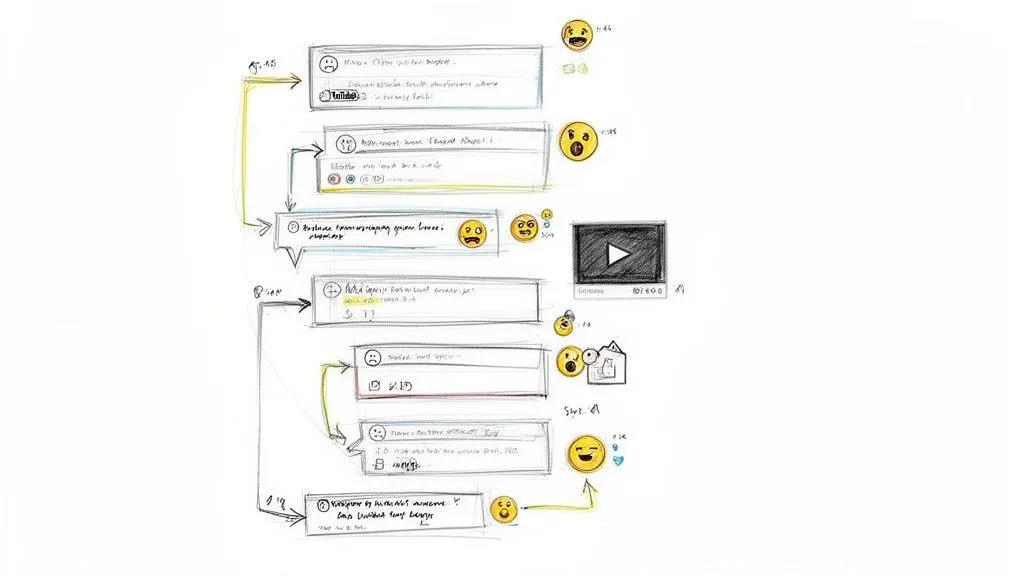
Imagine a YouTube comment thread as a real-life conversation happening in slow motion. Conversation Analysis (CA) is the method you’d use to diagram that chat, turn by turn. It’s all about the structure of the dialogue: who takes turns, how they agree or disagree, and when they shift the topic. This makes it perfect for understanding the social mechanics humming beneath the surface of YouTube discussions.
To even begin this kind of analysis, your data has to preserve the entire conversational structure. Manually trying to track who replied to whom in a thread with hundreds of responses is a fast track to a headache. An exported dataset that keeps the thread hierarchy intact is non-negotiable; it’s what lets you reconstruct the exact flow of the dialogue.
Once you have that structured file, you can start analyzing reply chains to spot key conversational patterns. We call these adjacency pairs, which are the fundamental building blocks of interaction. Think of a question and its answer, or a compliment and its response.
By studying these pairs, you can see how users work together to build common ground or, on the flip side, how disagreements escalate through specific conversational moves.
A Practical CA Workflow for YouTube Reply Chains
Let’s walk through a real-world scenario. Say you’re analyzing comments on a product tutorial to see how viewers help each other out.
- Isolate a Thread: First, export the comments. Then, pick out a long reply chain where one user asks a question and others jump in to help.
- Map the Turns: In your spreadsheet, find the initial question (the first part of the adjacency pair). From there, track each reply and note its function. Is it an answer? A follow-up question? A clarification?
- Code the Interactions: Now, label each turn. Are users offering solutions? Expressing gratitude? Or maybe correcting a piece of advice someone else gave? This process reveals the collaborative, problem-solving machine in action.
This systematic approach shows you not just that users are helping each other, but precisely how they structure their conversation to make it happen.
Understanding the Full Picture with Multimodal Analysis
YouTube conversations are rarely just text. They’re rich with emojis, timestamps that point to specific moments in the video, and even user avatars that add a layer of meaning. Multimodal Discourse Analysis is the method that looks at how all these different pieces work together. It’s built on the idea that a single emoji can completely change the tone of a comment.
Just think about the comments on a movie trailer. A text comment like “That scene was wild” is one thing. But “That scene was wild 🔥🤯” communicates a much more specific and intense reaction.
For a brand analyzing feedback, this is incredibly valuable. A simple 👍 or 👎 emoji next to a comment gives you immediate, unambiguous sentiment. Similarly, when users reference specific moments with timestamps (e.g., “The feature at 2:15 is a game-changer”), they are literally blending their text with a direct link to the visual media. A searchable data export makes finding and analyzing these multimodal cues simple and fast.
The built-in AI tools can also give you a head start by exploring the emotional tone and topics in your data. You can learn more about how our AI Analyzer can speed up your research.
By combining Conversation Analysis with Multimodal Analysis, you end up with a much richer, more complete understanding. You get to see both the architecture of the dialogue and the full palette of communicative tools (text, emojis, and video references) that people use to share what they really think and feel.
Your Step-by-Step YouTube Discourse Analysis Workflow
Diving into the rich, messy world of YouTube comments with a formal analysis method can feel like a huge undertaking. But don’t worry, it’s not as complex as it sounds. The secret is breaking it down into a clear, five-step plan that takes you from raw data to real insights.
The whole point of this workflow is to move from theoretical concepts to practical application. And the biggest shortcut? Starting with clean, analysis-ready data from the get-go. Manually collecting thousands of comments is a surefire way to burn out before you even begin. A structured export saves you hours of grunt work and lets you jump right into the interesting part: the analysis itself.
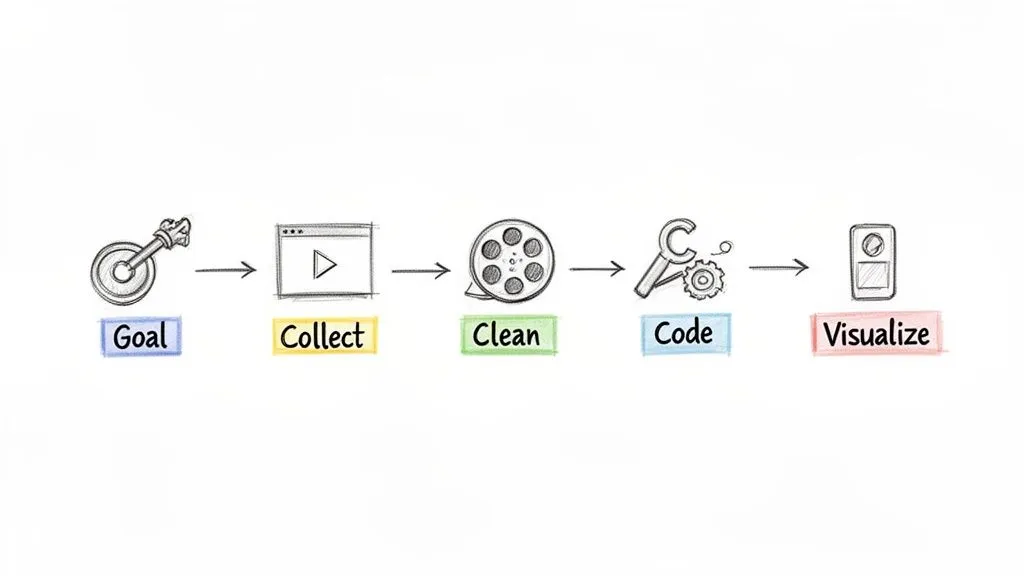
Here’s how you can tackle your next project, step by step:
1. Define Your Goal and Pick Your Method Before you even think about downloading data, you need to know what you’re looking for. Ask yourself: what’s the core question I’m trying to answer? Are you investigating how communities build shared identities? Or maybe you’re uncovering subtle biases in how people talk about a topic? Your question will naturally lead you to the right method, whether it’s Critical Discourse Analysis for power dynamics or a Narrative Approach for storytelling.
2. Collect Your Data Once you have a clear goal, it’s time to gather your raw material. Use a comment downloader tool to pull the comments you need. The key is to export them as an XLSX or CSV file. This gives you a neatly organized dataset from the start, complete with not just the comment text but also vital metadata like timestamps, author details, and reply counts, all ready for you in separate columns. If you need a refresher, our guide on how to extract YouTube comments walks you through this crucial first step.
Clean, Code, and Visualize Your Findings
With your data downloaded, the real fun begins. These next steps are all about sifting through the noise to find the signals that answer your research question.
3. Clean and Sample Your Dataset You might be looking at an export with 750,000+ comments. That’s way too much to handle at once. The first thing you need to do is filter it down to a manageable size. Use Excel’s filters to isolate comments from a specific date range, focus on threads containing certain keywords, or zero in on the most-liked comments. If the dataset is still too big, take a random sample to create a smaller, yet representative, subset.
The goal of cleaning isn’t to throw away data; it’s to sharpen your focus. A well-defined subset of comments is far more powerful than a massive, unfocused dataset.
4. Code and Analyze the Discourse This is where you put your chosen method into action. In your spreadsheet, create a few new columns for your “codes.” For example, if you’re doing a Frame Analysis, your codes might be columns like “Problem,” “Solution,” and “Moral.” As you read through your sampled comments, you’ll tag each one with the appropriate codes. This is the part where you methodically transform qualitative observations into data you can actually measure and compare.
5. Interpret and Visualize Your Results Now that your comments are coded, you can finally step back and see the bigger picture. Use Excel’s formulas to count how often different codes appear or create pivot tables to spot trends. Do certain themes appear more often in replies than in top-level comments? Answering questions like these is the heart of your analysis.
Finally, bring your findings to life with charts and graphs. Visuals are essential for turning a spreadsheet full of codes into a compelling story. For a broader perspective, you might even find it useful to see how to analyze YouTube Shorts performance, as this can add valuable quantitative context to your qualitative discoveries. This final step is all about making your hard work clear, persuasive, and easy for others to understand.
Answering Your Top Questions About YouTube Discourse Analysis
Alright, let’s tackle some of the practical questions that pop up when you start digging into YouTube comments. Moving from the “what” of discourse analysis to the “how” is where the real work begins, and getting these details right will save you a lot of headaches down the road.
Is It Actually Ethical to Use Public YouTube Comments for Research?
This is a big one, and rightly so. The short answer is yes, it’s generally considered ethical. Because YouTube comments are posted in a public space, there’s no reasonable expectation of privacy. Think of it like analyzing letters to the editor in a newspaper.
But the ethical buck doesn’t stop there. The best practice, and the most respectful approach, is to completely anonymize your data. That means stripping out usernames and any other personal details before you even think about publishing your findings. Your focus is on the conversation and the patterns within it, not the individuals having it.
A good rule of thumb: treat the data with the same respect you’d want your own public words to be treated. Your goal is to shed light on broader social trends, not to put individual users under a microscope.
What’s the Best Data Format to Work With?
This really comes down to your comfort level with different tools, but for the vast majority of researchers, XLSX (Excel) and CSV files are the gold standard. These spreadsheet formats are like a Swiss Army knife for data analysis; they work with almost everything and make sorting, filtering, and coding a breeze.
- XLSX/CSV: These are your go-to for manual coding. You can create new columns for your codes, use pivot tables to summarize findings, and run simple formulas to spot patterns. They are the workhorses for this kind of research.
- JSON: If you’re comfortable with a bit of programming (like Python), JSON is an excellent choice. It’s fantastic at preserving the nested structure of comment threads, which is perfect for mapping out complex back-and-forth conversations.
- TXT: A simple text file is most useful when you just need a massive dump of raw text to feed into a natural language processing (NLP) tool or an AI model for a quick thematic overview.
How Do I Handle a Truly Massive Dataset?
It’s easy to end up with a file containing over a million comments, especially from a popular channel. Trying to open that in Excel is a recipe for a frozen computer. Don’t try to boil the ocean. Instead, get smart with sampling.
Your first step is to filter your exported XLSX or CSV file for a more manageable subset. Maybe you only care about comments that mention a specific keyword, or perhaps you’re only interested in the discussion from a particular month.
If that’s still too much, it’s time to create a random sample. For most studies, a randomly selected sample of 1,000 to 5,000 comments is more than enough to identify the significant patterns in the discourse. You get all the insight without the technical overhead.
Ready to stop copying and pasting and start analyzing? The YouTube Comments Downloader can pull thousands of comments from any video, Short, or channel and drop them into a clean, analysis-ready spreadsheet in seconds. Get the structured data you need to put these powerful methods into practice.