6 months ago
Mastering a YouTube Comment Scraper GDPR Compliant: 2026 Guide
Using a youtube comment scraper GDPR compliant tool is fundamental to conducting ethical and sustainable research in 2026 and beyond. A properly designed tool focuses on pseudonymized data like comment text and author handles. This allows you to perform market research or sentiment analysis under a clear lawful basis, all without harvesting sensitive personal details. This is the only safe way to turn public YouTube discussions into valuable insights for your specific use case.
Understanding YouTube Data Collection in the GDPR Era

The General Data Protection Regulation (GDPR) completely reshaped how we handle data, and YouTube’s massive comment sections are no exception. For marketers, researchers, and creators, these public threads are a goldmine of raw, unfiltered feedback. The catch? You have to navigate the data collection process very carefully to stay on the right side of the law.
The main hurdle is figuring out what counts as “personal data.” Under GDPR, even a simple username can be considered personal data if it can be used to identify a person. This is where the difference between a generic data scraper and a purpose-built YouTube comment tool becomes so incredibly important.
The Dangers of Generic Scrapers
Let’s be blunt: generic data scraping tools are a huge liability for this task. They are often built to grab every piece of information they can from a webpage, which means you’ll almost certainly end up with personal data you don’t need and have no legal basis to process. That’s an instant compliance nightmare. Our product is not a generic scraper; it is specifically designed for YouTube data.
Using a generic scraper for YouTube comments could easily lead to:
- Accidental collection of sensitive information from user profiles.
- Violating YouTube’s Terms of Service, putting your account at risk of being banned.
- Massive GDPR fines, which can be crippling for any organization.
These risks aren’t just theoretical. The compliance landscape has tightened considerably, and enforcement is getting stricter. We saw this in 2025 when major companies faced record-breaking penalties, like Meta’s €1.2 billion fine for non-compliant data practices. These cases prove that GDPR applies to any company collecting data on EU citizens, no matter where it’s based. For a deeper dive, it’s always helpful to review dedicated GDPR compliance guidelines to understand the broader context.
The Compliant Path Forward
This is where a specialized tool like YouTube Comments Downloader comes in. It’s engineered from the ground up on two core GDPR principles: data minimization and pseudonymization.
Instead of scraping entire user profiles, it smartly focuses only on the data that’s actually relevant for analysis: the comment text, the author’s public handle, likes, and reply counts. This targeted method is designed for compliance from the start.
This approach lets you establish a “lawful basis for processing”—usually ‘Legitimate Interest’—for your research. You’re analyzing public discourse for trends and sentiment, not trying to track specific individuals. You can get a better feel for the technical side of this in our guide on using a specialized YouTube comment scraper API.
Ultimately, a compliant tool is much more than just a piece of software; it’s a core component of your data governance strategy. It helps you sidestep the legal headaches and financial risks of non-compliant data collection, putting your research projects on solid legal ground.
To make this easier to digest, here’s a quick summary of how these GDPR principles apply when analyzing YouTube comments and how a compliant tool helps.
GDPR Compliance at a Glance for YouTube Comment Analysis
| GDPR Principle | What It Means for YouTube Comments | How YouTube Comments Downloader Helps |
|---|---|---|
| Lawful Basis | You need a valid legal reason to process comment data. | Facilitates ‘Legitimate Interest’ by focusing on public sentiment, not personal tracking. |
| Data Minimisation | Only collect the data absolutely necessary for your goal. | Exclusively scrapes essential data: comment text, handle, likes, and replies. No excess profile info. |
| Purpose Limitation | Data collected for one purpose can’t be used for another without a new basis. | The tool is designed for a specific purpose—sentiment and market analysis of public comments. |
| Pseudonymisation | Process data in a way that it can’t be tied to a specific individual without more info. | Focuses on public handles, which are pseudonyms, rather than real names or direct identifiers. |
This table should give you a clear, at-a-glance overview. By choosing the right tool and a compliant process, you can confidently turn public comments into powerful insights without running afoul of regulations.
Navigating GDPR when you’re just trying to analyze YouTube comments can feel like walking a tightrope. The good news? You don’t need a law degree. I’ve found that focusing on three core GDPR principles turns confusing legal text into a practical, defensible game plan: Data Minimization, Purpose Limitation, and Pseudonymization.
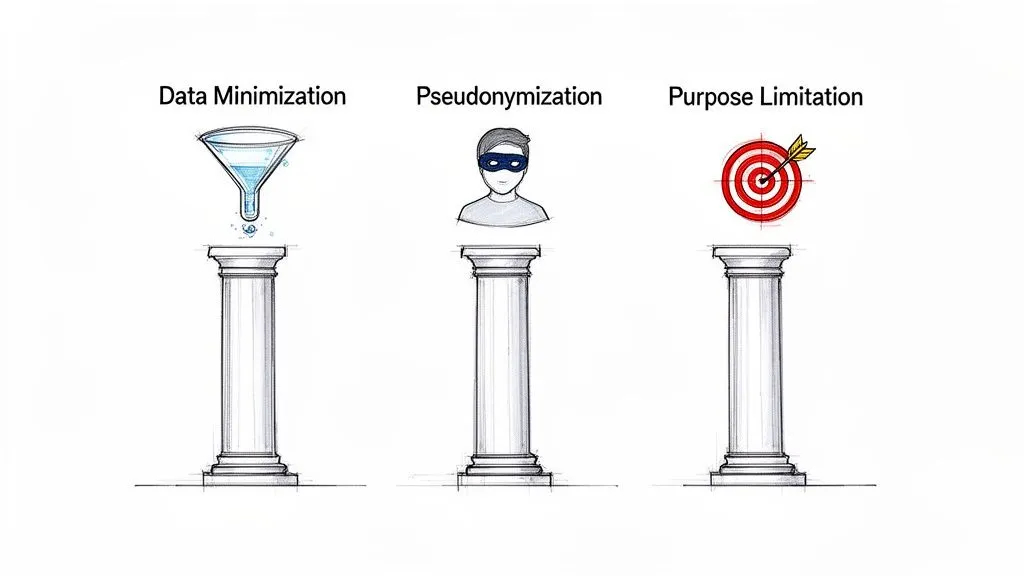
Get these right, and you’re not just compliant; you’re conducting ethical, responsible research. These aren’t just bureaucratic hoops to jump through. They are the bedrock of any solid data collection project, and they’re exactly what we’ve built the YouTube Comments Downloader to help you put into practice.
Data Minimization: Collect Only What Matters
Let’s be honest, the temptation with some data tools is to grab everything. But under GDPR, that’s a huge misstep. Data Minimization is the discipline of only collecting the data you absolutely need for your specific task. Generic scraping tools often get this wrong, pulling in a ton of profile details that just add legal risk without adding value.
Think about what you actually need for sentiment analysis. A marketer tracking brand perception doesn’t need a commenter’s profile picture or their entire channel history. They need the core data points:
- The comment text itself
- The number of likes
- The timestamp (to track trends)
- The reply structure (to see who is talking to whom)
This is why we designed YouTube Comments Downloader to be precise. It’s built to fetch only these relevant fields, giving you a clean dataset ready for analysis. By design, it avoids scooping up unnecessary personal data, ensuring your work is lean, targeted, and easy to justify.
Purpose Limitation: Define Your Goal First
You can’t just hoard comments and figure out what to do with them later. Purpose Limitation means you must know why you’re collecting the data before you even start. This purpose has to be specific, clear, and legitimate.
This step is your foundation for claiming ‘Legitimate Interest’ as your lawful basis, which is the most common path for this kind of analysis. For example, a solid purpose would be “to analyze customer feedback on our Q3 product launch video” or “to identify recurring pain points discussed in a competitor’s tutorial comments.”
By defining your purpose upfront, you’re drawing a clear line in the sand for your project. This not only keeps your research focused but also acts as your first line of defense if your methods are ever questioned. It’s proof that you’re doing targeted research, not conducting broad surveillance.
Many generic APIs leave this entirely up to you, offering raw power but no guardrails. Our tool, on the other hand, is built specifically for analyzing YouTube comments, which makes it much easier to align your project’s goal with GDPR’s requirements.
Pseudonymization: The Key to Safe Analysis
Pseudonymization is all about replacing personal identifiers with artificial ones, or pseudonyms. The great thing about YouTube is that it already does this for you with usernames and handles. A compliant tool has one job here: respect that separation and never try to link those handles back to real-world people.
The real danger comes from tools that can follow a user’s handle from a comment to their full profile page, scraping more personal details along the way. That act of linking a pseudonym back to an identity is called deanonymization, and it crosses a major legal and ethical line. Any tool that makes this easy is a liability.
A truly youtube comment scraper GDPR compliant solution is built to prevent this. For instance, YouTube Comments Downloader treats the handle as it appears on the comment: a simple label. This lets you analyze a user’s arguments within a single video’s discussion without ever needing to know who they are. It strikes the perfect balance, giving you the analytical power you need while keeping your work well within the bounds of the GDPR.
Choosing the Right Tool for YouTube Comment Analysis
Picking the right tool to pull YouTube comments is a huge decision, especially when you have GDPR breathing down your neck. This choice directly impacts the quality of your data, your legal exposure, and just how much technical grunt work you’ll have to do. Broadly speaking, you have two paths: go the developer route with a generic API or use a specialized, no-code tool like YouTube Comments Downloader.
For marketers, researchers, and creators, the real goal is to get from a nagging question to a solid insight as quickly and safely as possible. This is where the difference between the two approaches becomes incredibly clear. A specialized tool is like a perfectly calibrated wrench for one job, while an API is a box of parts that you have to assemble yourself.
The Developer API Route: A Complicated Path
Generic data scraping APIs are powerful, but they are not the right fit for everyone. For the average user, they come with some serious headaches. Platforms like these are built for engineers who live and breathe code, API keys, and raw JSON data.
If you head down this path, get ready for a steep learning curve. The process almost always involves:
- Serious Coding Skills: You’ll need to write scripts, likely in a language like Python, just to ask the API for data and make sense of what it sends back.
- A Messy Setup: You’re on the hook for managing authentication, handling API errors, and sometimes even setting up your own servers to run the scripts.
- Manual Data Wrangling: The API will dump raw data on you, usually in JSON format. It’s your job to clean it, untangle it, and convert it into something you can actually use, like an XLSX spreadsheet or CSV file.
This technical overhead is a massive roadblock. If you’re a marketer trying to figure out how people feel about a new product video, every hour spent learning to code is an hour you’re not spending on actual analysis.
A Look at API Providers
The market for scraping APIs is booming. A platform like Bright Data reports that over 20,000+ companies now lean on their infrastructure, driven by digital marketers who need to track competitor performance and consumer sentiment. While they offer ways to get comment data, their core products are still aimed at developers and are not a one-click solution.
Their ability to process 750,000 comments in under 30 minutes is impressive, but that kind of firepower is often overkill for a marketer or academic researcher. It also comes with the complexity and cost of an enterprise-grade solution better suited for large-scale operations. You can dig into the specifics of these advanced YouTube comment scraping solutions to see just how they’re built for huge operations, but for targeted analysis, a more focused tool is a better choice.
The real problem with these API-based solutions isn’t a lack of power; it’s accessibility. They’re built for a technical audience, creating a bottleneck for anyone who just wants clean, analysis-ready comment data without becoming a part-time developer.
The No-Code Advantage with YouTube Comments Downloader
This is exactly where a purpose-built tool like YouTube Comments Downloader shines. We designed it from the ground up to eliminate the technical headaches and compliance risks that come with generic data collection methods.
Our tool gives you the most direct path from a YouTube URL to an actionable dataset. There’s no coding, no complicated setup, and absolutely no need to wrestle with raw JSON files. You get an instant, perfectly structured download in familiar formats like XLSX and CSV, ready to pop open in Excel or your favorite analysis software.
If you want to see how different tools stack up, our guide on the best YouTube comment scraper in 2026 breaks it down even further.
To make it even clearer, here’s a quick comparison of the two approaches. This table shows why a dedicated, no-code solution is almost always the better choice for non-developers who just need to get the job done.
YouTube Comment Scraper Tool Comparison
| Feature | Generic Scraping API (e.g., Bright Data) | YouTube Comments Downloader |
|---|---|---|
| Ease of Use | Requires coding and technical setup. | No-code interface. Simply paste a URL and click download. |
| Data Output | Raw JSON or NDJSON that needs parsing. | Analysis-ready formats like XLSX, CSV, and TXT. |
| Built-in Compliance | Compliance is the user’s responsibility. | Designed for GDPR with data minimization built-in. |
| Speed to Insight | Slow; requires development time before analysis. | Instant. Get from URL to dataset in seconds. |
| Target Audience | Developers and data engineers. | Marketers, researchers, and creators. |
The bottom line is simple. If your job is to analyze YouTube comments, not build software, the choice is clear. YouTube Comments Downloader gives you the speed, simplicity, and built-in compliance you need to focus on what actually matters: uncovering valuable insights from your audience.
How to Actually Collect and Analyze YouTube Comments Compliantly
Alright, let’s move from legal theory to the real world. Having a compliant tool is a great start, but knowing how to use it is what separates raw data from genuine insight. The whole process, from figuring out what you need to analyzing the final data, should be straightforward and fully aligned with GDPR principles. With a purpose-built tool like the YouTube Comments Downloader, you can skip the technical headaches and get straight to the good stuff: the comments themselves.
The first thing I always do is clearly define the project’s scope. This is a practical application of the GDPR’s Purpose Limitation principle which basically means, don’t collect data you don’t actually need. Your goal will shape what you collect.
- For Marketers: You might just need the comments on a single product launch video to get a quick read on public reaction.
- For Academic Researchers: Your project might be bigger, like scraping comments from an entire playlist of political debates to study how arguments evolve.
- For Content Creators: You might want to grab comments from your whole channel to find the most-asked questions for a future Q&A video.
The key is that the tool you use should match this flexibility. You want to be able to target a single video, a specific playlist, or an entire channel. This ensures your data collection is laser-focused on your research question.
From URL to Analysis-Ready Data
Once you know what you’re looking for, kicking off the export should be simple. I’ve seen people wrestle with developer APIs, writing code and trying to manage complex requests. A good tool is designed for clarity and speed: you just paste the YouTube URL and let it handle the heavy lifting.
At this point, you’ll face a critical choice: your output format. This isn’t a small detail; the right format depends entirely on what you plan to do next.
- XLSX for Excel: This is the go-to for most people. It gives you a clean spreadsheet where comments, author handles, likes, and timestamps are all in separate columns. You can start sorting, filtering, and creating charts right away.
- TXT for AI Analysis: If you’re planning to feed the comments into a large language model like ChatGPT, a clean text file is what you want. A good TXT export will be formatted as raw conversational data that an AI can process for thematic analysis or summarization without any extra cleanup.
This flow diagram really shows the difference between using a dedicated tool and trying to build your own solution with an API. The path is much more direct.
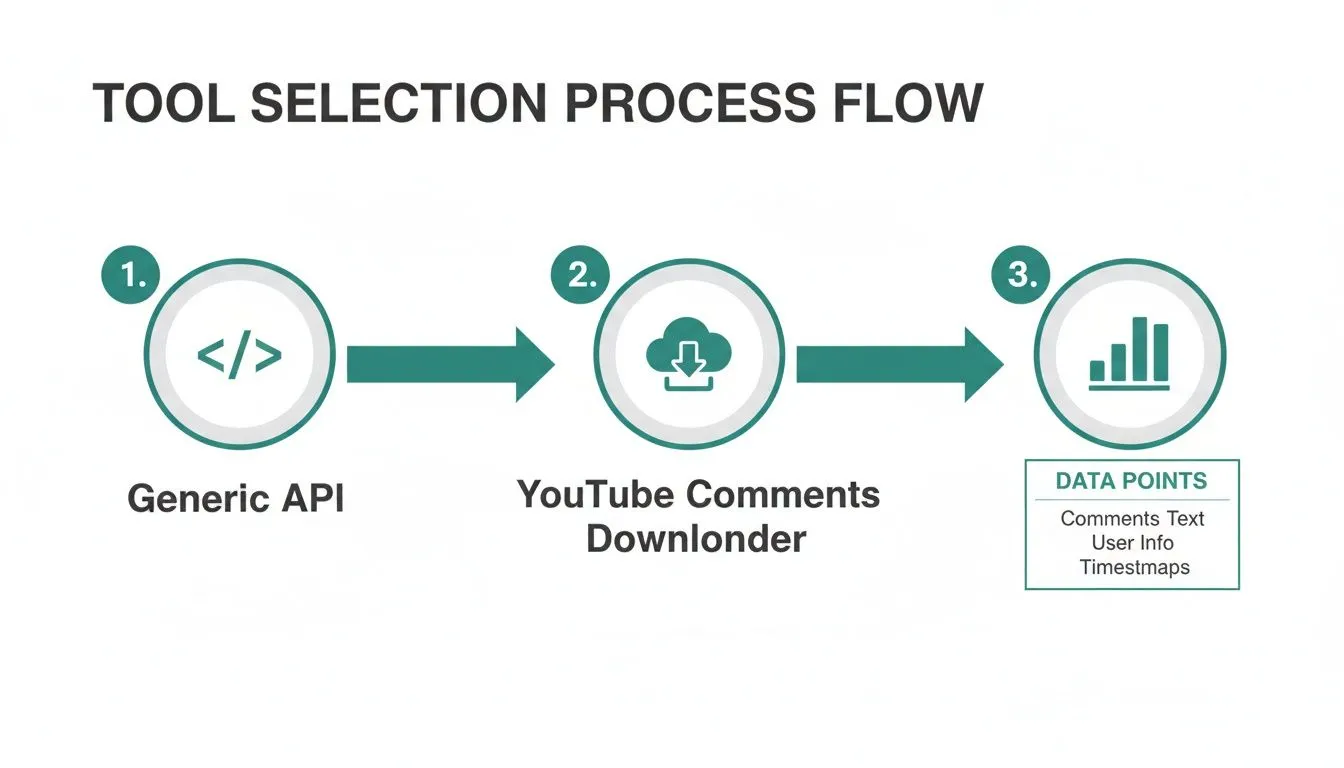
What this visual makes clear is how a tool like the YouTube Comments Downloader removes the technical barriers. It lets you go straight from your question to your dataset, no coding required.
Practical Analysis in Action
Now, with a clean dataset in your hands, the real analysis can start. The true value of a compliant tool is how quickly you can turn a wall of text into actionable insights.
Let’s say you’re a social media manager for a tech brand. You just launched a new phone, and the announcement video is buzzing with thousands of comments. With the XLSX export, you can open the file and use the search function to instantly find every mention of “battery life” or “camera quality.” This gives you immediate, hard numbers on the features your audience actually cares about.
Or, think like an academic researcher studying online communities. You could export comment threads from a series of videos and use the structured data to analyze reply chains. This lets you see who is really driving the conversation and how specific arguments unfold over time, all without compromising anyone’s privacy.
The ultimate goal is to move from a sea of comments to specific, evidence-backed conclusions. A well-structured dataset is what makes this possible, turning a chaotic discussion into an organized source of intelligence.
Managing Your Data After Collection
Getting the comments off YouTube is just the beginning. The real test of your GDPR compliance starts now, with that data sitting on your drive. How you handle, store, and ultimately get rid of this information is every bit as important as how you collected it.
This part of the process is all about the data lifecycle, specifically focusing on data retention and the rights of the people who wrote the comments. Nailing this ensures your project stays on the right side of the law from start to finish.
Setting a Clear Data Retention Policy
The golden rule of data retention under GDPR is refreshingly simple: don’t keep data forever. You should only hang onto the comment data for as long as you actually need it for your stated purpose. Hoarding datasets “just in case” is a clear misstep and goes directly against the regulation.
Don’t overthink it; your retention policy doesn’t have to be some dense legal document. It’s often just a straightforward rule you establish for the project.
- Short-term projects: Analyzing sentiment after a product launch? A reasonable policy might be to delete the data 30 days after you’ve finalized your report.
- Longitudinal studies: Tracking discourse over several months or years for academic research? The retention period will naturally be longer, but it must be clearly defined and justified in your documentation.
Once the data has served its purpose, it needs to be securely deleted. This means more than just dragging it to the trash bin; you need to make sure it’s permanently and irretrievably erased. For organizations that need to prove their processes are sound, looking into a framework like the SOC 2 Audit Process can be a game-changer. It provides a recognized structure for managing data compliantly.
Understanding Data Subject Rights
GDPR gives people significant rights over their personal data, including the well-known “Right to be Forgotten.” In theory, this means a YouTube user could find you and demand you delete their specific comment from your dataset.
In reality, for the kind of pseudonymized data gathered by a youtube comment scraper GDPR compliant tool, this scenario is extremely rare. Since your focus is on public discourse and you aren’t trying to link usernames to real-world identities, the chance of receiving such a request is very low.
The principle is what’s important here. By using a tool like YouTube Comments Downloader that prioritizes pseudonymized data from the outset, you dramatically reduce your compliance burden. You haven’t collected a rich profile on anyone, so your ability to pinpoint a specific person is limited, which is exactly what GDPR’s privacy-by-design philosophy encourages.
This approach is fast becoming the industry standard. By 2025-2026, the compliance landscape for data tools has matured significantly. Leading platforms now often show adherence to multiple regulations at once, like GDPR and CCPA, ensuring that even commercial use of data respects individual privacy. It all comes down to the ethical line between legitimate analysis and collecting data without proper consideration.
By managing your exported files with care, you complete the data lifecycle responsibly. If you want to dive deeper into the practical side of handling the data files themselves, check out our guide on how to export YouTube comments to CSV and other formats. This final step ensures your valuable insights don’t accidentally become a future liability.
Frequently Asked Questions
When you’re dealing with data, especially from a place as public as YouTube, a lot of questions pop up around legality and privacy. It’s smart to ask them. We get these all the time, so here are some straight answers based on our experience with GDPR and data collection.
Is It Legal to Scrape Comments from YouTube?
Yes, scraping public YouTube comments is generally legal, but it comes with two big caveats. You need to respect YouTube’s Terms of Service, and you absolutely must follow privacy laws like GDPR. It’s not a free-for-all.
This is where a purpose-built tool like YouTube Comments Downloader makes a difference. It’s designed to fly under the radar by not requiring your personal YouTube account or API keys, which helps you avoid breaking platform rules that could get your account flagged. More importantly, it focuses only on the public comment data: the text, the handle, the likes. This keeps your work in the realm of legitimate research, not risky data harvesting.
Do I Need Consent from Every Commenter?
For most research, market analysis, or sentiment tracking, the short answer is no. You don’t need to chase down every single person for their consent.
This is because your work likely falls under ‘Legitimate Interest’, one of the lawful bases for processing data under GDPR. This basis applies when your purpose is legitimate (like analyzing public opinion), the data processing is necessary for that purpose, and you’ve minimized the privacy impact on individuals.
A tool that supports a ‘Legitimate Interest’ claim is your best friend here. For instance, YouTube Comments Downloader provides pseudonymized author handles instead of direct links to personal profiles. By design, it processes the data in a privacy-conscious way from the very beginning, making ‘Legitimate Interest’ a solid and defensible foundation for your project.
General-purpose data tools can get you into trouble because they often grab too much data, making it much harder to justify your work as having a minimal privacy impact. That’s when you might cross the line into surveillance, which would definitely require explicit consent.
How Is This Tool Different from an API?
I like to think of it this way: an API is a box of car parts for a mechanic, while our tool is the finished car, ready to drive. An API is incredibly powerful if you’re a developer, but for everyone else, it’s a technical nightmare.
If you were to use a generic scraping API from a provider like Bright Data or ScrapingBee, you’d be responsible for:
- Writing and debugging your own code, likely in Python or JavaScript.
- Managing API keys, handling authentication, and figuring out what to do when requests fail.
- Sorting through raw, messy JSON data to pull out the information you actually need.
YouTube Comments Downloader skips all that. You just paste a YouTube video URL, click a button, and get a clean spreadsheet (XLSX or CSV). It’s the most direct path from a YouTube video to a dataset full of insights, no coding required. This makes it a superior solution for marketers, researchers, and creators who need results, not a coding project.
What Happens If a Comment Is Deleted After I Download It?
Great question. The data you download is a snapshot: a moment frozen in time. If a user deletes their comment from YouTube after you’ve exported the data, that comment will still exist in your downloaded file.
This highlights just how important a good data retention policy is. Your responsibility is to use the data for your stated purpose and then get rid of it. Once your analysis is done, you should securely delete the dataset. This respects the spirit of data privacy, even if a user’s “Right to be Forgotten” request isn’t made directly to you, and ensures you aren’t holding on to outdated information indefinitely.
Ready to turn YouTube comments into actionable insights the compliant way? YouTube Comments Downloader gives you the power to collect structured, analysis-ready data from any video, channel, or playlist in seconds. Start for free and see how easy it is to conduct research without the technical headaches or legal risks. Get started with YouTube Comments Downloader today!