7 months ago
How to Find Niches on YouTube a Data-Driven Guide
If you want to find a great niche, stop guessing what people want. Start listening. The most potent, unfiltered business ideas are already out there, hidden in plain sight inside YouTube comments. This is where your future audience is talking, sharing their real-world frustrations, and practically begging for solutions.
Why YouTube Comments Are Your Niche Goldmine
Think about most niche research. It usually starts with keyword tools. While those tools are great for seeing what people search for, they completely miss the why. You see the search term, but you have no idea about the emotion, the urgency, or the specific problem driving that search. YouTube comments are the missing piece of the puzzle, a direct line to the voice of your potential customers.
This is not about creating content for a niche you think exists. It is about discovering a niche that is already alive and active, looking for a leader. When you start digging into these conversations, you are not just guessing; you are gathering real market intelligence.
The Problem with Generic Niche Research
Let’s be honest: a lot of niche research feels like throwing darts in a dark room. You might find a keyword with decent search volume, but you have no clue if there is a passionate, paying audience behind it. This often leads to creating videos no one watches or products no one buys.
Comment data from YouTube is your proof of demand. It is where people get specific.
- Unfiltered Needs: You will find viewers openly discussing what they wish the creator had explained differently or in more depth.
- Product Gaps: They will mention tools they wish existed or specific problems they just can’t seem to solve with current options.
- Emotional Signals: Look for words like “frustrated,” “confused,” or “finally, this makes sense!” These are powerful clues pointing directly to pain points and opportunities.
The real gold is in the questions people are asking. A comment with hundreds of likes that says, “but how do you apply this to a small business budget?” is not just a question. It is a massive signpost pointing to an underserved sub-niche.
This is exactly what we mean by sifting for gold. You are looking for those valuable nuggets of insight buried in the stream of everyday chatter.
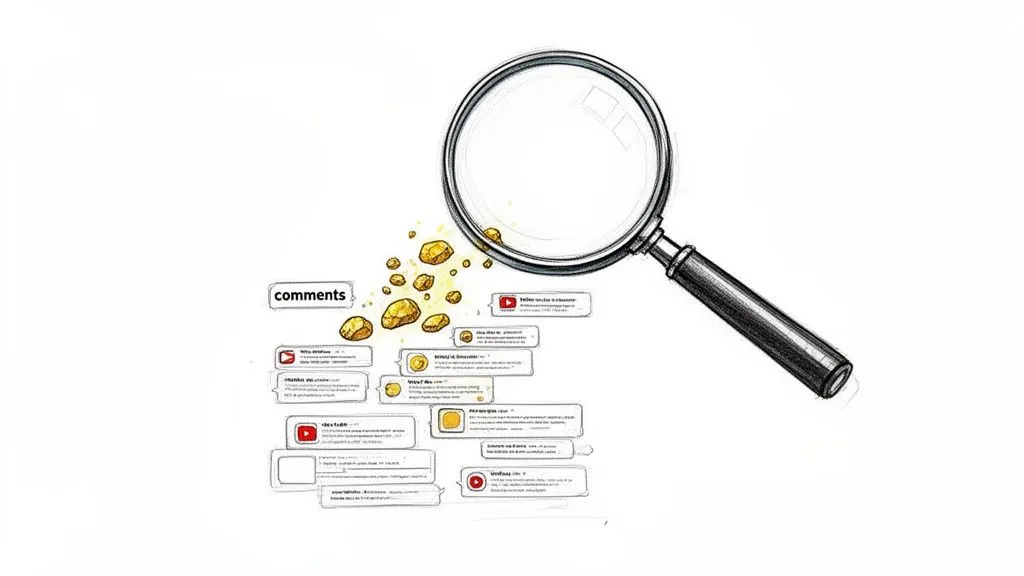
Of course, manually reading thousands of comments is a nightmare. That is where a specialized tool like a YouTube Comments Downloader comes in. It lets you pull all that chaotic conversation into a clean, searchable format. You can turn a mountain of raw data into an organized database. For a deeper dive on how to interpret these conversations, our guide on discourse analysis methods is a great next step. This kind of structured approach lets you quickly spot recurring themes and validate your ideas before you ever hit “record.”
Framing Your Research Before You Download
I have seen countless people dive into niche research and come up empty. The mistake is almost always the same: they start with the tool, not the question. Before you even think about downloading a single YouTube comment, you need to know exactly what you are looking for. This is not about collecting data; it is about gathering intelligence.
Your best starting point is always your own interests. Genuine curiosity is the only thing that will get you through hours of sifting through comments. So, pick a broad topic you are genuinely passionate about, whether it is personal finance, sustainable living, or SaaS tools for small businesses. We will call this your “seed” topic.
From Broad Topics to Specific Questions
Got your seed topic? Good. Now, here is where the real work begins. The goal is to drill down from that general interest to a very specific question. Do not ask, “What’s popular?” That is a surefire way to find a market that is already saturated and hyper-competitive.
Instead, you need to start thinking like a problem-solver. Frame your research around pain points, frustrations, and unmet needs.
Before you can ask sharp questions, you have to know who you are asking them for. Taking some time to learn How to Identify Target Audience will make your research infinitely more effective.
Here is how this shift in thinking plays out in practice:
- Instead of: “What’s popular in personal finance?”
- You should ask: “What specific budgeting challenges do freelancers face that salaried employees do not?”
- Instead of: “What do SaaS users like?”
- You should ask: “What integrations do viewers of SaaS review channels constantly request that do not exist yet?”
- Instead of: “What are some fitness trends?”
- You should ask: “What are the biggest frustrations people over 50 mention when starting a new workout program?”
See the difference? This simple change moves you from being a passive observer to an active investigator. The YouTube Comments Downloader becomes your precision instrument, not just a shovel. This is the core skill behind how to find niches that actually have a hungry, underserved audience.
A well-framed question acts as a filter. It instantly makes certain comments pop, allowing you to completely ignore the surrounding noise. You are hunting for patterns of specific problems, not just chasing general popularity.
I always think of it like a detective showing up at a crime scene. A rookie just starts bagging random evidence. An experienced detective has a working theory and looks for specific clues to prove or disprove it. Your research question is that theory. The comment data is your evidence. This is, by far, the fastest way to turn thousands of comments into a real, validated business idea.
Targeting High-Value Niches with CPM Tiers
Let’s talk about the money. When you are first learning how to find a niche, it is easy to get fixated on view counts. But a million views on a cat video and a million views on a stock trading tutorial are worlds apart financially.
The secret is to follow the advertiser’s money. Your goal should be to find niches where audiences are not just watching. They are actively looking for solutions and are ready to spend. This is where a little metric called CPM becomes your best friend.
CPM, or Cost Per Mille, is what advertisers pay for every 1,000 views on a video. A high CPM means advertisers are competing to get in front of that audience, which is a massive signal of a lucrative niche. A finance channel might only need 100,000 views to earn what a gaming channel earns with millions. That is working smarter, not harder.
The Power of High-CPM Categories
Think of YouTube as a digital map of commercial intent. Some areas, like finance, software, and health, are bustling downtown districts. Others, like general entertainment, are more like quiet suburbs. Advertisers pay a premium for a storefront in the busy areas.
When you point a tool like a YouTube Comments Downloader at channels in these high-value categories, you are essentially eavesdropping on conversations with built-in buyer intent. The comments section of a video about tax software is a goldmine of unmet needs just waiting to be turned into a product or service. You can dig deeper into this with these YouTube niche insights.
To really see the difference, it helps to look at the numbers. The potential earnings between categories can be staggering. Here is a quick breakdown of what advertisers are willing to pay for different audiences.
2026 YouTube Niche CPM Estimates
A comparison of potential earnings across different YouTube niche categories, highlighting where advertisers are willing to spend the most per thousand views.
| Niche Category | Estimated CPM Range ($) | Audience Motivation |
|---|---|---|
| Personal Finance & Investing | $18–$45 | Wealth building, problem-solving |
| Legal & Tax Education | $15–$40 | High-stakes advice, risk mitigation |
| Business & Entrepreneurship | $14–$35 | Growth strategies, tool discovery |
| Real Estate | $12–$30 | Major life decisions, investment |
| Software/SaaS Reviews | $10–$25 | Productivity, business efficiency |
| Gaming | $3–$8 | Entertainment, community |
As the data shows, the financial upside of choosing the right niche from the start is enormous.
A finance channel can potentially earn more than 10 times the ad revenue of a gaming channel with the same number of views. This data is not just interesting; it is a strategic roadmap for your research.
This framework gives you a massive strategic advantage. Instead of randomly analyzing comments from the trending page, you can focus your efforts where they will have the biggest financial payoff. The comments on a video about “real estate investing for beginners” will give you far more monetizable ideas than the ones on the latest viral challenge.
By starting your search in these lucrative corners of YouTube, you are setting yourself up to find opportunities that have a real, validated business model from day one.
Your Workflow for Finding Niches with Comment Data
Okay, you have got your research question locked in and you know which high-value categories to explore. Now for the fun part: putting that theory into action. This is where we turn the often chaotic chatter of public discussions into a structured goldmine of ideas. It all starts with aiming your research tool at the right content.
Instead of just yanking comments from a few viral videos, you need to think bigger. Think in terms of entire channels and playlists. A creator’s whole library or a playlist focused on a single topic gives you a much richer, more contextualized pool of data. Using a tool like YouTube Comments Downloader, you can process entire channels at once. I am talking about turning thousands of videos and hundreds of thousands of comments into a clean, searchable file in just a few minutes. This is how you get a real market overview, not just a snapshot.
Finding Unmet Needs in the Data
Once you have the raw comment data, the real detective work begins. Rather than reading every single line, which would take forever, you can run targeted searches to find the gems. Your goal is to spot recurring problems that the creator and the community are not solving.
Here is what I typically look for:
- Pain Point Language: Start by searching for emotionally charged words. Think “frustrated,” “stuck,” “confused,” or even specific problem phrases like “hair loss” or “crypto scams.” These are direct signals of audience struggles.
- Product Requests: People will flat-out tell you what they want to buy. Search for phrases like “I wish there was a tool for,” “no-code tool for,” or “can you recommend a…”
- Unanswered Questions: A flood of comments asking the exact same question with few or no replies is a massive opportunity. It points to a clear content gap or a need that is being completely ignored.
A promising sub-niche is not just a popular topic. It is a topic with a high volume of specific, emotional questions and a noticeable lack of helpful answers. This signals a community actively searching for a solution that does not exist yet.
This is precisely how you find opportunities that have real monetary value.
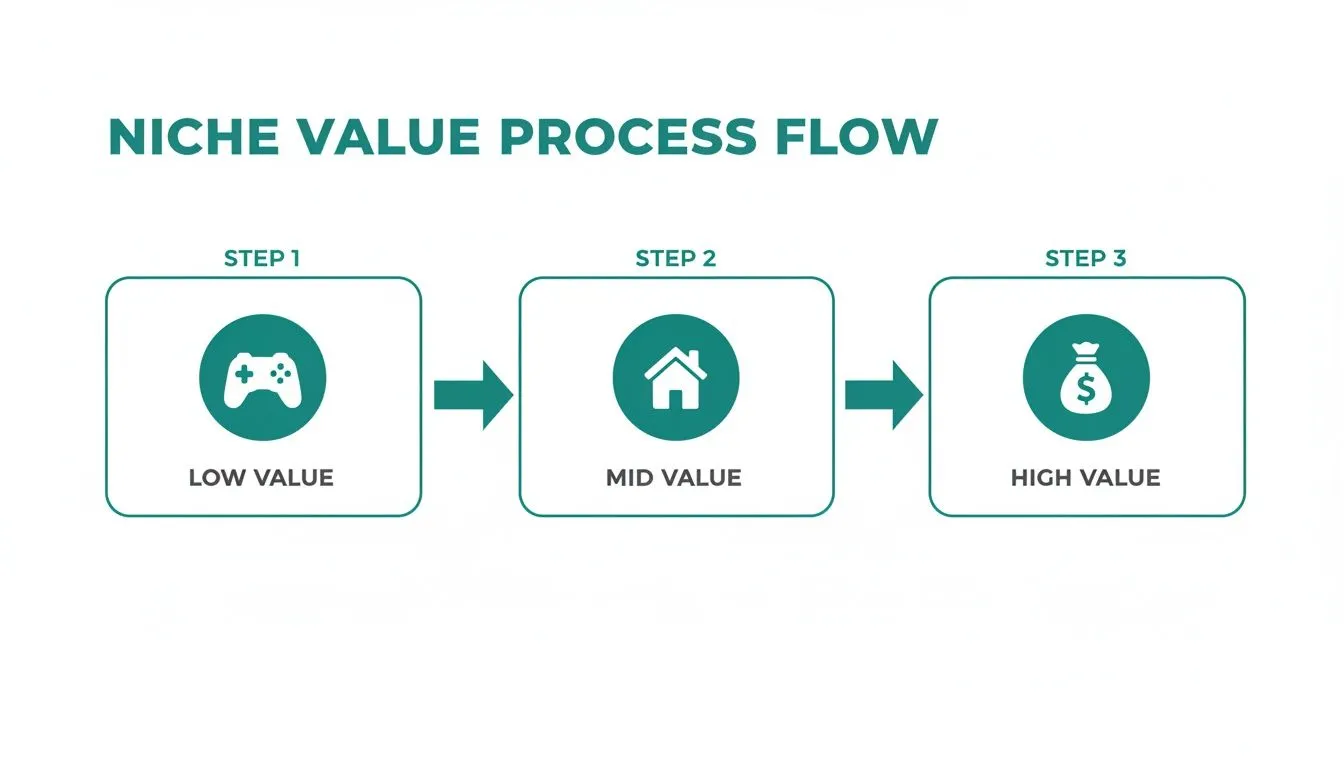
As the graphic shows, moving from broad entertainment topics toward specific, problem-solving areas in high-value categories is where the real potential lies.
Spotting Blue Ocean Opportunities
To find those truly low-competition “blue oceans,” you need to layer this workflow with a bit of audience economics. For instance, you could use a comment downloader to pull all the comments from Kids & Education channels, which generally have a modest $3–$8 CPM. Inside that data, you might search for a hyper-specific term like “homeschool hacks for dyslexia.”
If you find community posts where that question gets over 500 replies from many different people, you have likely stumbled onto a blue ocean. As you get a feel for niche economics, you will see how finance outliers, like topics around emergency plumbers, can hit a $50+ CPM using keywords mined directly from comments. You can find more on these blue ocean niches and their potential.
This is where a dedicated tool is a game-changer. Manual analysis is far too slow and inefficient for this kind of deep analysis. Our tool was built specifically for this workflow, giving you the scale and precision you need. For a full breakdown of what it can do, check out our guide on how to download YouTube comments for analysis. This process is your repeatable system for finding valuable niches that everyone else is missing.
Validating Your Niche with Niche Bending
So you have found a pocket of unanswered questions in YouTube comments. That is a fantastic start, but an idea is just that: an idea. Now you need to make sure it has legs and figure out how you will stand out from the noise. For that, I turn to a strategy I call niche bending. It is not about just filling a gap; it is about creating your own category.
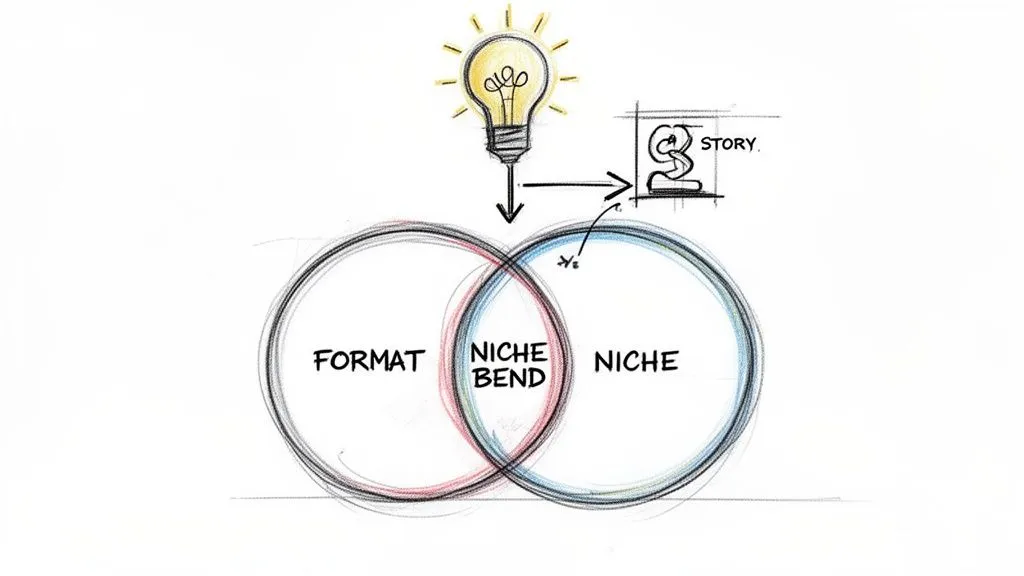
The approach is refreshingly straightforward. You take a proven, viral content format from a totally unrelated space and apply it to the underserved audience you just discovered. This lets you show up with a completely fresh angle, using a content style that people are already hooked on. You sidestep the direct competition and immediately capture attention.
Fusing Formats with Underserved Audiences
Think about the formats that pull you in on YouTube. Maybe it is the suspenseful storytelling of a true crime documentary, the fast-paced “day in the life” vlogs from tech founders, or the deep analytical breakdowns from sports commentators. Now, what if you took one of those and applied it to your niche?
- Example 1: Your comment research uncovered a hunger for content about “business failures and the lessons learned.” Instead of creating another dry case study, you could “bend” the format. Imagine applying the dramatic, story-driven style of a true crime channel to dissect a famous startup’s collapse.
- Example 2: You found a sub-niche of architects complaining about their clunky client management software. You could borrow the “unboxing and first impressions” format from tech reviewers and apply it to different SaaS tools for architects.
This is the secret sauce for learning how to find niches that can actually scale. Creator Tim Danilov has seen incredible success with this, reportedly taking faceless channels to significant monthly incomes in just 30 days. His method involves fusing high-engagement story formats, like those seen in NFL coverage, into brand-new markets to avoid the saturated “red oceans.” He explains it all in his breakdown of the niche bending strategy.
Using Comment Data to Perfect Your Angle
This is where all that comment data you gathered becomes critical for a second time. Once you have picked your niche and a format to bend, you can use the audience’s own words to refine your new content.
By analyzing the specific language your audience uses, you are not just guessing what resonates. You are building your content’s voice directly from their conversations, turning a creative idea into a data-backed strategy.
Export the comments as a TXT file using a tool like YouTube Comments Downloader and feed it into an AI model. Ask it to identify the top 10 recurring emotional pain points or the most common technical jargon. This tells you not just what to talk about, but how to talk about it in a way that connects instantly.
Let’s say your analysis of comments from a business channel keeps flagging phrases like “drowning in cash flow” and “terrified of a fatal mistake.” Now you know your “true crime” style videos on business failures should lean heavily into themes of financial anxiety and high-stakes decisions. Your content will not just be interesting; it will feel like you are reading their minds.
You can get more ideas on how to turn raw data into these kinds of insights by using a social media research tool. This final validation step takes niche bending from a clever trick and makes it a repeatable system for launching successful projects.
Frequently Asked Questions About Niche Research
Diving into YouTube comments for niche ideas can feel a bit like searching for a needle in a haystack, especially when you are just starting. I get it. A few common questions always pop up, so let’s tackle them head-on to clear the path for your research.
The whole point of this method is to stop guessing and let real, engaged audiences tell you exactly what they want.
What If I Don’t Know Which Channels to Start With?
This is a great question, and the answer is simpler than you think: start broad. You do not need a perfect channel in mind right away. In fact, it is better if you do not.
Begin by searching YouTube for a high-level topic you are interested in, preferably in a field with good monetization potential like “investing for beginners” or “SaaS reviews.” Your first goal is not to find the niche, but to find the audience.
Look for a few big videos with lots of comments. As you scan through them, you will start to see viewers mentioning smaller, more specialized channels they love. Those mentions are pure gold. They are your direct leads to the next layer of your research.
This iterative process is exactly what the YouTube Comments Downloader was built for. You can pull all the comments from a major creator’s channel and let their audience’s own words guide you to the more focused communities you are looking for.
How Many Comments Do I Need to Find a Niche?
It is tempting to think more is always better, but that is not the case here. Quality trumps quantity, every time.
Think about it: a single video with 10,000 comments where 500 people are all asking the same specific, unanswered question is an incredibly strong signal. It is far more valuable than a video with 100,000 comments that are just variations of “Great video!”
As a practical starting point, I would suggest grabbing the comments from a playlist of 10 to 20 highly relevant videos. You can always expand from there. Our tool is built to process over 750,000 comments in a hurry, so do not worry about overwhelming it.
The real key is to use the search features to spot patterns. Look for questions with a high number of ‘likes’ but almost no helpful replies from the creator or other viewers. That is a blinking red light indicating a clear, unmet need.
Are There Other Niche Research Methods?
Of course, but they often lack the authentic voice of the customer that makes YouTube comment analysis so powerful. It is one thing to know what people search for, and another to know why they are searching for it.
Let’s compare some alternatives:
- Keyword Research Tools: Tools like Ahrefs or Semrush are great for gauging search volume. They show what people are typing into search engines. The problem? They show you the query, not the pain behind it. You see “best accounting software” but miss the context that the searcher is a freelancer struggling with late payments. These tools are a good supplement, but they do not provide the ‘why’.
- Trend Analysis Platforms: Following trends can work, but it is a risky game. What is hot today might be forgotten tomorrow. This approach often leads to chasing fleeting interest rather than building a business around a timeless problem. It’s a short-term tactic, not a long-term strategy.
- Manual YouTube Browsing: Simply watching videos and reading comments one by one is better than nothing, but it is incredibly slow and inefficient. You can’t see the big picture or spot large-scale patterns. It is like trying to survey a forest by looking at one tree at a time. A specialized tool allows you to analyze the entire forest at once.
By analyzing YouTube comments with a dedicated tool like ours, you gain direct, scalable access to an audience explaining their problems in their own words. It is the most reliable way I know to find a solid foundation for a successful channel, product, or service.
For a wider look at finding opportunities, this guide on how to find profitable niches offers some great strategies that pair nicely with this comment-focused approach.
Ready to stop guessing and start listening? The YouTube Comments Downloader turns public discussions into a searchable database of real opportunities. Start for free and find your next winning niche today.